
All Episodes
EPISODE 18
·
·
22:52
Access is different depending on where the patient came from
Jason Muchow
·
CEO,
Five months into the CEO seat at Advanced Bone & Joint, Jason Muchow ran a patient journey mapping exercise from the point of decision through discharge and billing. He explains what it revealed about ABJ's shifting referral base, why a new EMR was not the move in month five, and how employers, squeezed by rising medical spend, are becoming a referral channel of their own.
LATEST · E-- · —
0:00 / 0:00

The Board's Charge Came on Day Two, Not Day One
It's One Thing to Promote. It's Another to Have Access.
Top takeaways
1. Coming into a 40-year seat, the first move was listening, not fixing
Jason Muchow's predecessor held the CEO seat at Advanced Bone & Joint for 23 years, at a practice that has served its St. Louis-area community for over 40. Understanding what got the organization to where it is came first, before any changes.
He leaned on the framework from The First 90 Days, and right out of the gate the focus was people: multiple listening sessions, anonymous staff surveys, and a simple diagnostic question, are we giving everyone the resources they need to perform at their best. His logic: culture handled well internally is what patients experience the moment they walk in.
2. The board's charge arrived on day two, not day one
The instinct to prove yourself fast is real, and Jason is direct about the risk of moving too quickly and leaving the team behind. But the mandate didn't wait for him to settle in, it came in his first board meeting, his second day on the job: execute on growth initiatives, and make sure the team already in place is sustained.
Both at once, from day two. The resolution wasn't picking one, it was spending the first 90 days building understanding before building strategy on top of it.
3. Patient journey mapping found friction the team hadn't looked for in years
Jason's team mapped the patient journey from the point someone decides they need care through discharge, billing, and payment, a process the existing admin team hadn't run through in some time. The goal was diagnostic: for each friction point, is it caused by the tool itself, a poor implementation, missing training, or a bolt-on layered under the EMR that inhibits it.
One concrete finding: online scheduling only worked for established patients. A new patient had to go through a separate, less clean process, submitting information, then waiting for the team to call and coordinate. A fix was already in motion before Jason started.
4. The referral base didn't disappear, it moved
Ten years ago, ABJ had a strong local primary care base that referred in consistently. Many of those same providers are still in the community, but now employed by one of the three major health systems headquartered in St. Louis, and encouraged to keep referrals internal. The trust built over decades hasn't vanished, but the volume has dropped.
Word of mouth has become the more resilient channel, the payoff of 40 years and an intentionally built culture. Layered on top: the region has seen the highest population growth of any community in Missouri over five years, and many new residents arrive already attached to one of the three health systems, simply unaware an independent option exists. Direct primary care is a newer wrinkle Jason is tracking, since its founders often share ABJ's own instinct, access when the patient needs it.
5. Employers are becoming a referral channel of their own
Brokers are telling Jason that employer medical spend is running 10%+ higher year over year, with premium increases potentially in the double digits, as high as 20%. That pressure is pushing employers to look for lower-cost access points, and independent orthopedic practices are positioned to be one.
ABJ's pitch isn't only rate contracts. It includes education, making sure an employer's workforce knows the practice's 24/7/365 injury chat (through Hatch) and its orthopedic urgent care exist as alternatives to the ED. Two tools, and awareness of them alone could reduce unnecessary ED admissions for an employer's population.
6. Access isn't one thing, it changes shape by channel
Jason's framing, confirmed back to him mid-conversation: how you talk about access depends on where the patient is coming from. A patient finding the practice online wants seamless self-scheduling. An employer relationship is closer to B2B, it starts with education, then an easy inflow. Workers' comp is about strengthened relationships and faster responsiveness.
Access for the sake of access isn't the strategy. Matching the access experience to the channel is.
Bonus: knowing which fights not to pick
Asked whether ABJ would expand into a more saturated part of the St. Louis market, Jason's answer was that it would only make sense with a fundamentally different care model, one that looks and feels different and delivers more access, and he's not sure yet what that would be. Rather than chase a crowded market, the near-term bet is deepening the strategies already in motion where the practice already has strength and presence.
Questions this episode answers
What should a new leader do in their first 90 days at a medical practice?
Listen before changing anything. Jason Muchow used the framework from The First 90 Days by Michael D. Watkins when he took over as CEO of Advanced Bone & Joint, and his first move was running multiple listening sessions and anonymous staff surveys rather than a reorganization. His diagnostic question was simple: are we giving everyone the resources they need to perform at their best. Understanding the existing culture came before building any new strategy on top of it.
What is patient journey mapping in a medical practice?
Tracing every step a patient experiences from the moment they decide they need care through discharge, billing, and payment. At Advanced Bone & Joint, the exercise revealed that online scheduling only worked for established patients — a new patient had to go through a separate, manual process of submitting information and waiting for a callback. The mapping also gave the team a way to diagnose friction: is it the tool itself, how it was implemented, missing training, or a bolt-on layered under the EMR.
Why is primary care no longer a reliable orthopedic referral source?
Because many primary care physicians who used to refer consistently are now employed by large health systems and encouraged to keep referrals internal. Jason Muchow, CEO of Advanced Bone & Joint, describes this exact shift in the St. Louis market, where three major health systems are headquartered. The trust built with those providers over decades hasn't disappeared, but the referral volume has dropped — which is part of why word of mouth and other channels, like employer relationships, have grown in importance.
Why are employers becoming a referral channel for orthopedic practices?
Because employer medical spend is climbing, and independent practices can offer a lower-cost access point. Jason Muchow cites brokers reporting medical spend running 10%+ higher year over year, with premium increases potentially reaching 20%. Advanced Bone & Joint positions itself to employers partly through direct contracted rates and partly through education — making sure employees know about services like 24/7/365 injury chat and orthopedic urgent care, which can prevent unnecessary ED visits.
How can a practice tell if friction comes from a tool or its implementation?
By mapping the patient and staff journey and asking, at each friction point, whether the tool itself is the problem, whether it was implemented poorly, whether staff lack training on it, or whether a bolt-on layered under the core system, like an EMR add-on, is inhibiting it. Jason Muchow's team at Advanced Bone & Joint ran this diagnostic explicitly rather than assuming a new EMR was the answer, concluding a full system replacement was not the right move five months into his tenure.
Scale referral operations to drive growth and efficiency
Full transcript
Transcript
[00:00:00] And specialty healthcare growth is not optional, but scaling with operational excellence. That's the hard part. I'm Joe Zboch. This is Scaling Specialty Growth.
[00:00:09] Joe: Thanks for listening. Today's guest is Jason Muchow, CEO of Advanced Bone & Joint, a physician-led orthopedic practice serving the St. Louis Metro with 26 providers across three locations. Jason spent nearly 17 years at Mercy Health System building their sports medicine and orthopedics program, and he started his career as a certified athletic trainer.
[00:00:28] Joe: And right now, his focus at ABJ is becoming the easiest orthopedic group to work with in the region for patients, for referring providers, and the employers sending people there. Jason, welcome.
[00:00:38] Jason: Thank you. Appreciate the opportunity.
[00:00:40] Joe: Yeah, this is gonna be fun. We've had some conversations leading up to this, and so I'm really excited for the conversation topics we have at play. And the first one I wanna start with is you're five months into a new role, right? And so you've been brought on kinda as this sustain-and-grow mandate.
[00:00:55] Joe: So walk me through how you start to implement a mindset. You mentioned a second ago that one of the things that has held true is a great culture at ABJ. So you've gotta be really strategic — okay, this is humming well versus over here we need to make some changes.
[00:01:12] Joe: So how do you go about developing relationships, building trust, so that you can till the soil and set the ground for where you wanna take the organization next? Give me a little bit of your philosophy here.
[00:01:23] Jason: Yeah, coming on board with an organization that's been here for well over 40 years, all here in this community, is understanding what got us to where we are today. My predecessor had served in this seat for 23 years, and so I had a lot to learn and take in to understand what is that current culture.
[00:01:43] Jason: What makes ABJ a place people love to come serve and take care of patients, and also a place patients enjoy coming to receive their care and have an excellent experience, from the moment they arrive to the moment they depart. There's a lot that comes into that. Some of the foundations I used were from the book The First 90 Days.
[00:02:02] Jason: There's a lot of great content in that. Highly recommend it to anybody starting a new role, no matter what the role is. It provided a framework of things to make sure I'm focusing on. And in this case, right out of the gate, it was the people. I held multiple listening sessions, sent anonymous surveys out to the team, and got a ton of feedback to understand where we are, where there are opportunities, and what are the things that make sure we provide the resources necessary so that everybody can perform at their best.
[00:02:32] Jason: And if you can handle that internally, that supports the culture, which continues to help provide the excellent experience our patients receive as they come to ABJ for their care.
[00:02:42] Joe: Yeah. I feel like there can be a temptation to prove yourself right out of the gate and start moving fast. But there's a real risk of leaving folks behind, and if you're gonna do anything in your seat, you have to have the team behind you.
[00:02:59] Jason: That's right. In fact, it was my second day, and it was my first board meeting. The charge given to me in that moment was to go execute on growth initiatives and make sure we sustain the team in place today. So knowing that, and understanding you don't want to disrupt too much, especially in your first 90 days, was to understand where things are and then begin to build your strategy after the fact.
[00:03:26] Joe: I think that's a good transition, because a little later I wanna talk about the patient journey mapping exercise you ran, which in a lot of ways is a foundation of some of the work you're doing now. But when you have the growth initiatives directive, tell me about that process and how you started to evaluate the landscape.
[00:03:48] Joe: In our pre-interview, you told me some interesting things about the St. Louis market. So understanding the market, understanding the organization — what did that process look like, and what did you learn as a tee-up for some of the projects you've been working on?
[00:04:00] Jason: The St. Louis market itself is an interesting one around orthopedics. You have a nice blend of both independent practices in the metro area, as well as three of the largest health systems in the country headquartered in our backyard.
[00:04:15] Jason: Understanding the dynamics that come with that competitive landscape, it's beginning to understand what ABJ can do to differentiate ourselves in that market, and then how do we properly communicate that to the patient base and our community so they can resonate with what it means to seek healthcare here.
[00:04:34] Jason: That originally started with me needing to understand what our marketing team looks like. We've got a third party we work with that came on less than a year ago and completely revamped the website and executed a strong digital marketing campaign — more than just meta ads, but also a lot of paid search and Google promotion.
[00:04:59] Jason: As we know, that tends to be where patients start if they're unfamiliar or don't have prior relationships. So we've spent the better part of the last nine months educating and engaging the community in those digital efforts, and then ensuring we have the access on the other end.
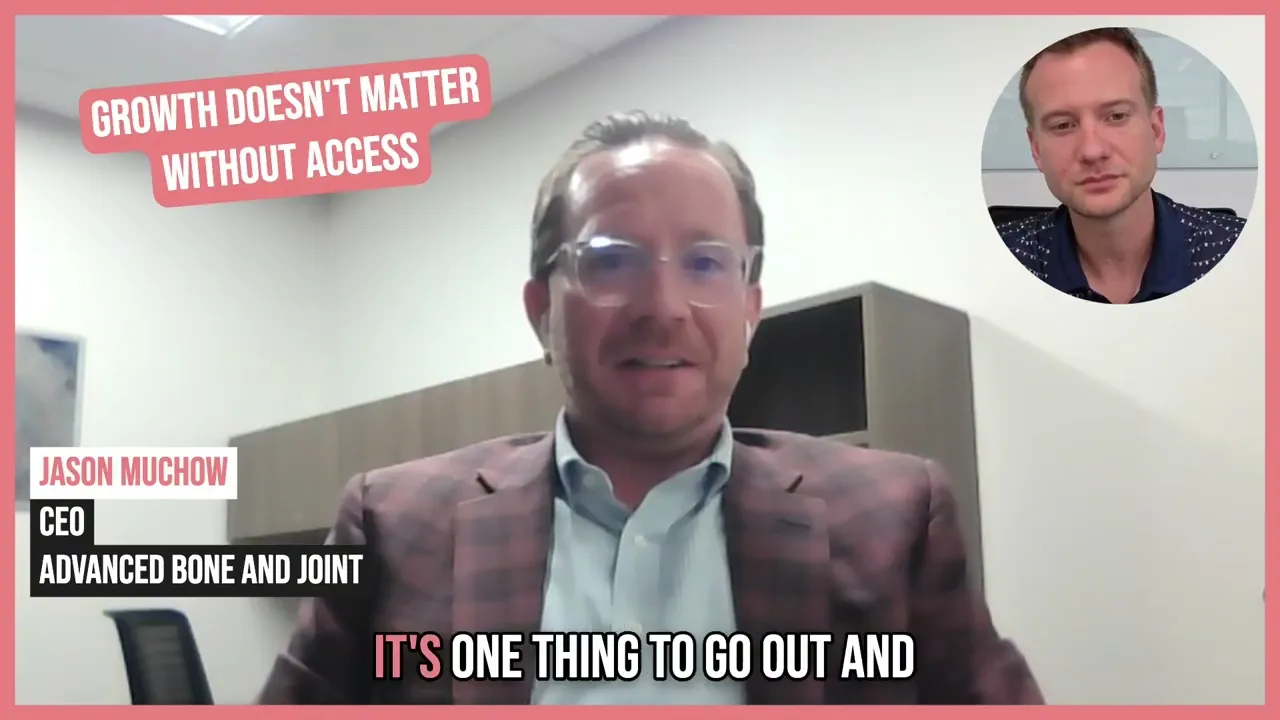
[00:05:17] Jason: It's one thing to go out and promote and create all this awareness and draw patients to come see you. It's another thing if you don't have access. And to this benefit, the team has been very intentional to ensure that access is in place, whether through individual appointments or our orthopedic urgent care and walk-in care services.
[00:05:41] Joe: Okay, so tee this up for me. You're five months in, you're understanding the landscape, and there are three large health systems in the space. It can be a big temptation to see what everybody else is doing. But if you're driving your car and looking to the left or the right, you're gonna crash.
[00:05:58] Joe: And so I think you did something really interesting that I haven't heard a lot of leaders talk about, which is you rolled up your sleeves and mapped out ABJ's patient journey. Can you tell me about what that work looked like, and the strategic thinking behind it? Because clearly it's led to some specific growth initiatives that have a stronger foundation because they're moored to a really great understanding of your patients.
[00:06:25] Jason: Yeah, absolutely. As a new leader coming in, I needed to better understand what our patients experience at the moment they decide they need access to care — whether it's an appointment, or they've had a long-lasting ailment but today's the day they needed to get in and see somebody — and ensuring that process is as smooth as possible.
[00:06:45] Jason: And to be honest, it isn't. But that means there's opportunity and willingness to really adapt and adopt new opportunities, whether new tools and technologies, but really — where are the friction points our patients experience.
[00:07:04] Jason: But also, where do our staff and providers feel friction points that maybe bog down their day, or slow their ability to properly document patient visits and get through their day so they can go home on time? There are so many facets to that process I needed to better understand.
[00:07:24] Jason: The existing admin team hadn't been through this exercise in quite some time. As we're going through this, we have multiple technology solutions in place, and part of the assessment is determining whether the friction is driven by the technology or tool, or whether the tool is actually good but wasn't implemented correctly or without appropriate education on how to leverage it.
[00:07:58] Jason: Or is there an underlying bolt-on to, say, our EMR that inhibits its ability to function as smoothly as it could? We mapped this journey from the point of decision to access an appointment or visit, all the way through discharge, the revenue cycle side of things — how patients receive their bills, pay their bills.
[00:08:22] Jason: How do we properly help patients know what they owe and anticipate that, so they can plan accordingly? We are just about complete through that process — the admin team started it, and then we took what we put together and gave it to the teams doing the work today, engaging with patients on the phones, to get their input and make sure we're capturing everything we can.
[00:08:45] Jason: And then the real work starts after that — beginning on that front end. We'll continue our campaign efforts and marketing initiatives, and now we've gotta make sure that the point from seeing the ads to becoming a patient is smoother than ever. That's one of many steps we need to address and turn on to make it a very convenient experience.
[00:09:11] Joe: Yeah. Before we get into some of the access and growth-related projects, can you tell me any insights, surprising or not, or friction points that this patient journey mapping exercise revealed? And as a rider to that — did you find that some were bigger than others because they involved patients, staff, and physicians, to where it's like, this is a big flashing red light, fix this?
[00:09:43] Jason: Well, the one that was somewhat surprising — but at the same time I didn't know what I didn't know coming in — is a lot of individuals brought up, well, our EMR could be better, or different, or new. This organization has gone through a couple changes in its EMR history, and being respectful of that, knowing that's no small undertaking, it's not one I wanted to go execute in my first five months.
[00:10:14] Jason: Nor do we have the full support to tackle that solution right now. I have no doubt it'll come in the future — no real timeline yet. That was one significant piece impacting everybody, from patients to staff to providers.
[00:10:31] Jason: One thing I noticed right away is we have the ability for online scheduling, but only if you're an established patient. If you're a new patient, there's a separate process — not as clean, not as simple — involving submitting information and then our team calling to coordinate the appointment.
[00:10:51] Jason: As you have these exchanges of communication, we know there's opportunity there, and to my benefit, there was already a solution in the works prior to my start to help fix delays on the phones. There isn't a medical practice that isn't struggling on the phone side of things in some form or fashion.
[00:11:13] Jason: But that's where technology's gonna come into play. We're seeing it across healthcare in general. I've implemented a similar type of service in my past life, so knowing it's there, that's a key solution that really satisfies patients.
[00:11:28] Joe: Yeah. What did you learn about the inflow of patients — where they come from, whether self-directed or referrals from other sources? What did you learn there, and how has that shaped some of the projects you're now rolling out?
[00:11:44] Jason: Yeah, our market probably isn't that much different than others across the country. Probably ten years ago we had a really strong primary care base that would consistently refer in here. Many of those providers are still in this community, but now they're with one of the three health systems.
[00:12:02] Jason: And while they're strongly encouraged to keep those referrals internal, there's still trust with the providers that's been developed here for quite some time. So it's still there, definitely not at the volume it used to be from that existing local primary care base. But as I referenced earlier, ABJ has been here for over 40 years, and that reputation and intentional culture-building — word of mouth has been a key referral source for ABJ.
[00:12:35] Jason: The other piece is this market has seen the highest growth of any community in the state of Missouri over the last five years. A lot of people are moving into the community, many not relocating within the county itself but coming from other counties around us.
[00:12:56] Jason: Through that growth, there are inevitably patients coming with established relationships at one of the other three health systems, and they're just not aware of the other choices — especially what that means from an access, experience, and ultimately cost perspective between a health system and a private practice.
[00:13:25] Jason: So we're doing a lot of work engaging that community growth that has happened here. The other side is we're seeing a trend in primary care that started to bubble up around COVID and has escalated since — direct primary care.
[00:13:44] Jason: There are different ways to go about it. No direct primary care is like any other — each is unique in how they deliver care and access. But fundamentally, why they set it up the way they did is to get back to providing the best care they can when the patient needs it, and having access at that point in time.
[00:14:08] Jason: So as I'm meeting with those individuals in our community and the surrounding area, I'm reminding them that our foundations and intentions are pretty similar — we're here to provide access when the patient needs it, ensuring the right specialist, and ensuring that from a cost perspective it's reasonable.
[00:14:27] Jason: It's not built up in the way that can happen, since many DPC providers historically have been employed by a hospital or health system at some point in their careers. That's an interesting trend I'll continue to monitor, not only locally but nationally, to see where things change from a primary care base standpoint.
[00:14:50] Joe: I think it's fair to say many patients aren't well-informed about the hard cost difference between going with a local independent versus a health system. There's almost this prevailing sense of, I have health insurance, so what does it matter — which cheapens it a little bit, to make a blunt point.
[00:15:15] Joe: The reason I bring this up is you've talked a lot about access and the awareness side of things for the practice, and some of what you're doing on the marketing side, the inflow of patients from other counties with existing relationships.
[00:15:26] Joe: Dovetailing that with the changing referral stream on the PCP side — getting snapped up by health systems — but also the rise of DPC, it brings me to this idea of employer-sponsored healthcare, almost the employer health system. Dig into this a little, because I think it's a hot and relevant topic for orthopedics.
[00:15:47] Joe: If you're working with direct primary care, or even workers' comp and nurse case managers, adjusters, carriers, or directly contracting with employers, the nature of your business model as an independent is aligned in a way that maybe doesn't exist with the big three health systems.
[00:16:08] Joe: So there's real incentive to work together — not just on the steerage side, but the access side, because the cost is lower. That strategic access is a new skill, a new muscle. I've said a lot — first, tell me if I'm off base, and second, what have you done at ABJ to get ready for this shift in referral streams and how patients find and access care?
[00:16:38] Jason: You're spot on. We're seeing it across the musculoskeletal community nationally right now, especially in independent and private practice spaces — for all those same reasons, how can we bring value to our local employers and become a preferred resource for their employees and dependents?
[00:16:56] Jason: It happens in multiple ways. It could be a direct contract, as you referenced, with agreed rates and a commitment on access. But also going in and understanding — could we just be a conduit to help educate them about our access, our 24/7/365 injury chat capabilities through Hatch?
[00:17:15] Jason: And leveraging our orthopedic urgent cares in lieu of traditional urgent care, or especially preventing ED visits. With our access, we can often help prevent that — just those two tools alone could help reduce ED admissions if the employee base and dependents are aware they exist and how to access them.
[00:17:44] Jason: It can go in multiple directions to help them. The interesting thing is, from networking with local brokers and others, I've heard employers across the country are seeing higher medical spend than normal — somewhere to the tune of ten percent plus year over year.
[00:18:08] Jason: Therefore, a lot of brokers are anticipating double-digit, maybe as high as twenty percent, increases to premiums. While that's concerning from a cost and budgeting perspective, there's opportunity to identify ways to reduce that spend and look to independent practices like ours as a solution and access point.
[00:18:35] Jason: There's no cookie-cutter approach, but that's the reality, and we're seeing it — so it's great we have an opportunity to be part of that solution.
[00:18:48] Joe: Yeah, I love hearing that. It goes back to patients and what they think of, which is why I love the marketing approach you guys have around education and access. If I'm an employer with a large population on my plan, I want the default MSK option to be the local independent rather than the ED.
[00:19:12] Joe: That's an education gap you're well-positioned for. Going back to what you said earlier, it's settling in my mind that how you market, frame, and package access is different based on the channel the patient originates from.
[00:19:30] Joe: Online, out in the wild — more seamless self-scheduling is the answer. If they're part of an employer, that's more of a business-to-business arrangement that starts with education and easy inflow. On the workers' comp side, it's strengthening relationships and being faster and more responsive.
[00:19:48] Joe: So access for the sake of access isn't quite it. But strategically, it sounds like you're very intentional about how you frame and talk about it based on the channel or avenue these patients originate from.
[00:20:04] Jason: That's exactly right. And also creating and leveraging platforms that help a freer flow of information depending on who needs access to it — that's an area of opportunity too. We hear a lot from patient feedback that the portal is good but could be better. Those are the things we're trying to capture as we look at how to improve that.
[00:20:25] Jason: So even the patient feedback is telling us where we have opportunities to create a less frictionless experience for them.
[00:20:33] Joe: So tell me, looking forward, what are you guys working on next? What's the next big project that'll have some bumps along the way, but you're excited about for ABJ?
[00:20:45] Jason: A lot of it is continuing the progress we have today — these aren't short projects, they're long-term and sustaining opportunities. I'm excited about continuing to network and grow my connections in the community. While I've been in St. Louis for many years, there are still a lot of leaders I've never met and have the opportunity to engage with.
[00:21:05] Jason: It just helps create connectivity and awareness, from old grassroots efforts, if you will. I think there's still value in that. And healthcare isn't easy, so where we're going to continue to thrive and accelerate and build on what's in place today — the future looks quite promising, especially in our surrounding community and network.
[00:21:33] Jason: Somebody asked me if we'd ever enter a more saturated part of St. Louis for orthopedics and MSK, both independent and health system — a lot of choice for patients. I said, while we could go into that market, it would have to be with a completely different care model — different look, different feel, greater access and experience for patients.
[00:22:02] Jason: I'm not really sure what that would look like yet, but that would be the only way, since it's a very highly competitive market. I think knowing our strengths is to keep with them, keep the presence where it is, and keep pushing ahead and forging on with a lot of the different strategies we have in play today — some of which are being developed as we speak.
[00:22:27] Joe: Jason, thank you so much for your time and your wisdom. I'm looking forward to the great work that you and the team at ABJ are doing.
[00:22:34] Jason: Thank you. Appreciate the opportunity. It was great having a conversation with you.
Hey, it's Joe. Thanks for listening. If you like what you hear, share with the peer, and if you're looking to scale referral operations to drive growth and efficiency, visit hatchcare.com.