
All Episodes
EPISODE 16
·
·
22:01
When growth sits at the center of the org chart
Blair Primis
·
Chief Growth Officer,
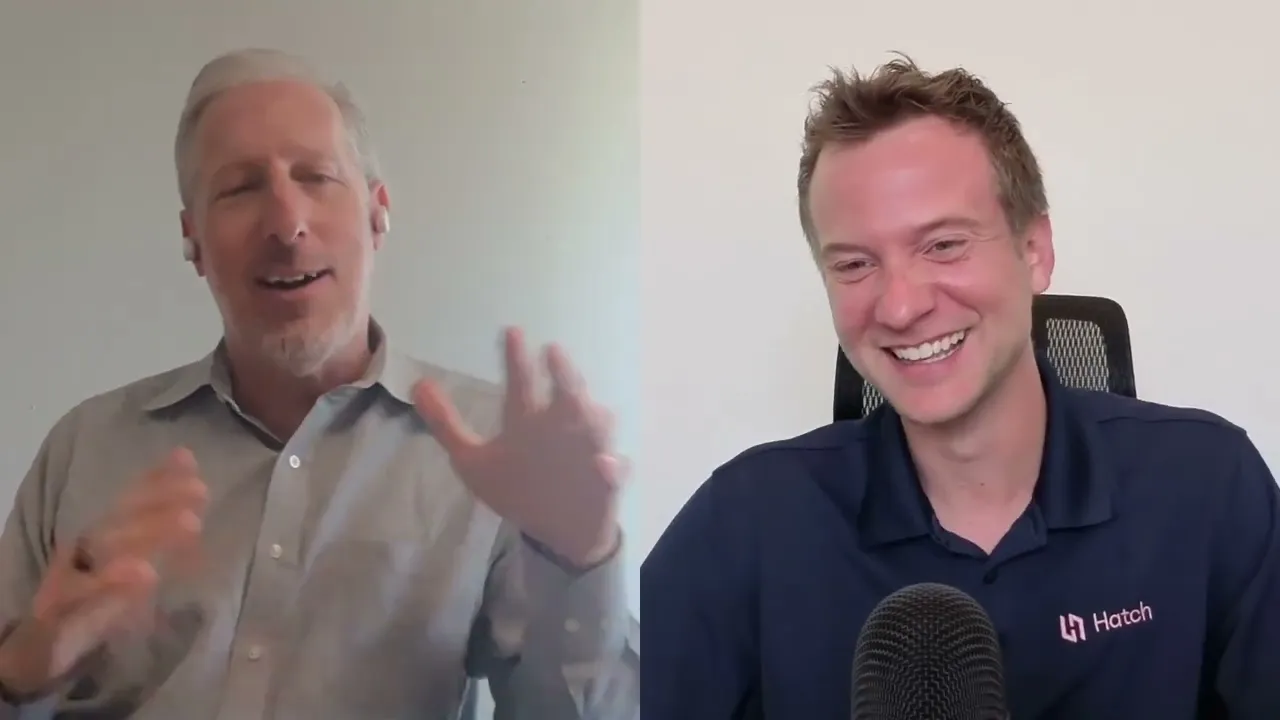
Blair Primis is Chief Growth Officer at OrthoCarolina, a physician-owned practice with more than 130 physicians across 40 North Carolina locations. He explains why OC codified growth as its own department rather than splitting it across marketing, operations and finance, and how full-funnel attribution data gave him the standing to ask 90 physician shareholders to change their schedules.
LATEST · E-- · —
0:00 / 0:00
Nobody Owns Growth Because Everybody Does
Schedule First, Solve Later
Top takeaways
1. If growth is the strategy, it needs a department, not a committee
OrthoCarolina started building a growth function at the end of Q4 2024 and formally stood up the department in early 2025. Blair's argument for it is blunt: if growth is the strategy, it shouldn't be scattered across the org, with the CEO the only person driving it across every pillar.
The department runs three lanes, each with its own director:
Demand — the marketing team.
Supply — a partnership with operations covering hall space, practitioner locations, real estate, and physician recruiting.
Experience — the patient-facing side, from the contact center to online scheduling to pre-registration.
The shape is hub and spoke. Growth sits at the center of the org and liaises out to operations, IT and Epic, legal, and the ASC team, rather than each of those groups owning a slice of growth separately. Blair's framing for what belongs to his team: if simplifying the work comp process or hiring a pre-registration role makes the practice easier to choose, that's a marketable win, so it's growth, not ops.
2. The data isn't the hard part. Changing behavior is.
OC spent five to seven months building full-funnel marketing attribution — the ability to trace a digital campaign all the way to a patient arriving in the office. It runs on Epic plus Freshpaint, with Placer.ai, real estate partner data, Google Business Profile and census data feeding in alongside. Blair is candid that the consolidation is a work in progress: clean on one dashboard, rough on another, and by his own measure the team is at midfield rather than in the red zone.
What the attribution work surfaced wasn't a marketing problem at all. The obstacle was that online booking asked patients too many questions, and the funnel showed exactly where they dropped out. The team had suspected it. The data made it arguable.
That distinction is the takeaway. Blair separates the technical work from the behavioral work and is clear that the second is harder: the data set only earns you the right to ask people to change. He believes in gut instinct, but pairs it with intentional data because the combination is what moves a room.
3. "Schedule first, solve later"
OC had run the opposite model — a highly intentional, highly detailed scheduling process, which Blair says produced leakage and missed scheduling opportunities. The fix was to get the appointment first and let staff manage the complexities of subspecialty orthopedic scheduling afterward.
Selling it meant standing in front of 80 to 90 physician shareholders at a retreat and recommending changes to their schedules. The pitch was built on the team's projection that removing friction could produce meaningfully more new patient appointments — Blair's own framing was a range, from several hundred to a couple thousand. He describes it as a projection used to justify the change, not a result being reported.
4. Your friction is public, and your competitors can see it
This is the sharpest argument in the episode. There's no secret to getting an appointment at an orthopedic practice — anyone can call or go online, including your competition. So a visible 22-, 45-, or 60-day wait isn't only a patient experience problem. It's an open invitation for a competitor to open an office nearby and hire two physicians against you.
Blair's line to physicians and staff came from a Jerry Seinfeld keynote, on why Seinfeld ended after nine seasons: it was easier to get to the top than to stay there. Applied to a practice with a strong reputation, the only direction from the top is down, so defending market share takes more work than winning it did.
Bonus: what McDonald's taught him about physician-owned practices
Blair spent seven and a half years in corporate marketing at McDonald's before joining OrthoCarolina 14 years ago, and he used the parallel in his interview. A franchise system runs on convincing owner-operators in local markets to believe in a vision built at corporate — while spending their money. A physician-owned practice works the same way: leadership is hired to bring its best thinking, to push back, to be challenged. Take away the drive-throughs and the Super Bowl ads, he argues, and the governance is nearly identical.
Questions this episode answers
What does a growth department in a private practice actually do?
At OrthoCarolina it runs three lanes, each with its own director: demand (marketing), supply (a partnership with operations covering hall space, practitioner locations, real estate and physician recruiting), and experience (the contact center, online scheduling, pre-registration). It sits at the center of the org in a hub-and-spoke model and liaises out to operations, IT and Epic, legal and the ASC team, rather than each of those groups owning a piece of growth separately.
How do you get physician owners to approve changes to their schedules?
Pair the hunch with data that shows exactly where patients drop out. Blair Primis's team spent five to seven months building full-funnel attribution before he stood in front of 80 to 90 shareholders at a physician retreat to recommend the change. His point is that the data isn't the hard part — it only earns you the right to ask. The harder work is change management: hallway conversations with physicians about why their slots are moving.
What does "schedule first, solve later" mean?
Get the appointment booked with as little friction as possible, then let staff handle the complexity of subspecialty scheduling afterward. OrthoCarolina had run the opposite model — a highly intentional, highly detailed process that asked patients too many questions up front — which Blair Primis says caused leakage and missed scheduling opportunities.
Why is a hard-to-use scheduling process a competitive risk, not just a patient experience problem?
Because your availability is public. Anyone can call or book online, including competitors, so a visible 30-, 45- or 60-day wait tells a rival exactly where to open an office and hire two physicians against you. As Blair Primis puts it, showing friction openly invites competition into the market.
Scale referral operations to drive growth and efficiency
Full transcript
Transcript
[00:00:00] And specialty healthcare growth is not optional, but scaling with operational excellence. That's the hard part. I'm Joseph Zboch. This is Scaling Specialty Growth.
[00:00:08] Joe: Thanks for listening. Today's guest is Blair Primis, Chief Growth Officer at OrthoCarolina. OC is a physician-owned, physician-led orthopedic practice with over 130 docs and 40 locations across North Carolina. His role blends the strategic side of marketing with data-driven supply and demand matching for the practice.
He's responsible for driving revenue and growth for OrthoCarolina, from attracting new patients, of course, retaining existing ones, and improving the experience for everyone who touches the practice. Blair, welcome.
[00:00:38] Blair: Thanks for having me, man. Looking forward to it.
[00:00:40] Joe: Okay. In the conversation leading up to the recording today, we talked quite a bit about something that I think is really unique at OrthoCarolina, which is you have essentially a solidified, structured growth approach and department within OrthoCarolina. Usually I like to talk about the operational systems required to support aggressive growth goals.
At the size that OrthoCarolina is operating, clearly formalizing growth as a function is a clear part of that. Tell me the makeup of a group like this, and what your role is in leading that, because I think that's really gonna tee up some of the things that you and the team have done and accomplished over the past year or so.
[00:01:20] Blair: Yeah, appreciate it. There's definitely a sort of novel vibe to having a growth team or growth department in a private practice. This exists outside of healthcare — for the last decade and plus, 20 years. But in healthcare it seems somewhat novel, and most of it lives inside of health systems.
And so for a private group like us, it's been a lot of fun. In earnest, we've been at it really since the end of fourth quarter of '24, but properly formed the department in the beginning of '25. So we're a year and a half or so into this. It's really made up of three separate functions that view what growth would entail or what growth would mean for OC.
The good news is we've got a demand side department, which is our marketing team. We've got what we call our supply department, which is our partnership with the ops team for hall space and physician and practitioner locations. Our real estate team, so when we think about physical office locations and hall space opportunities. And then our recruiting team, where we think about physician recruiting, new practitioner growth.
And then our third team is the experience side. So we can be really good at demand, and then manage that demand with the appropriate amount of supply in the right place at the right time, and deliver a world-class experience. We sort of have this growth engine humming along. Those are the three lanes our team occupies. I've got directors in each of those slots, and then the four of us and the team underneath them all move forward in sync.
[00:02:55] Joe: What are your thoughts on why this model is novel for the private practice? Maybe in contrast to the health system — because I kind of grew up on the health system side and, speaking a little overly bluntly, it seems growth revenue with less heebie-jeebies, more very intentional. So maybe dig on that just a little bit. Sounds like you're vibing.
[00:03:16] Blair: Yeah. The epiphany around this was it's actually our best method for sustaining our existence. As an independent private practice, with lots of hospital and health system competition, other private practices in our market — we're gifted. This area of the country, I'm in the Southeast, I'm in Charlotte, North Carolina, we're gifted with a lot of growth, and it's a benefit. We're really lucky. There's places in the country that don't have the same kind of growth we do.
Having said that, it also invites more people to come and grab that growth. Like any business model inside or outside of healthcare where there's density and opportunity for growth, people open up franchise restaurants, they open up more coffee shops, they open up more car dealerships, we open up more healthcare. That's just how this works.
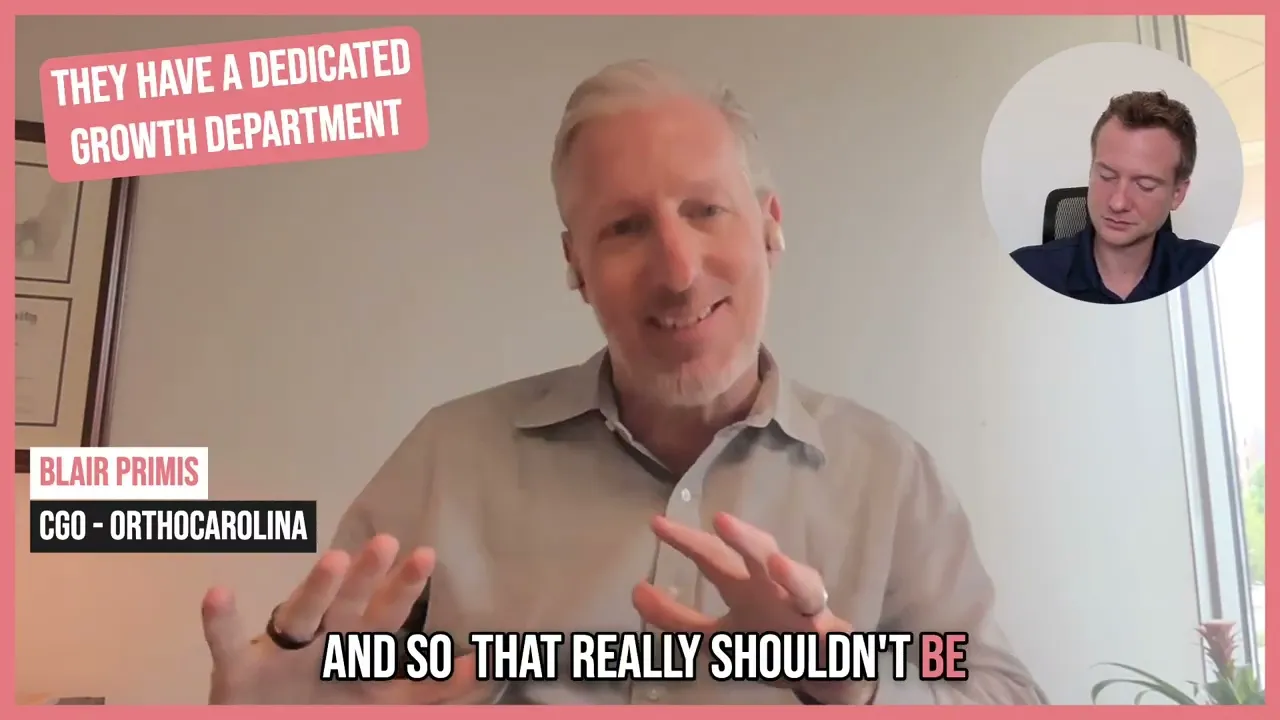
And so the goal here is to say, let's not just stand on our laurels. North Carolina's really lucky and has a well-earned reputation for quality and really outstanding outcomes. So don't rest on that. All gas here. Let's put our foot on the gas, let's go, and let's figure out ways for us to grow and expand. And if that's the goal, and we know that's our strategy, that really shouldn't be siloed across other departments.
You should have a singular department focused on that, which liaises with other groups. Do we need operations? Absolutely. Do we need our ASC team? Absolutely. Clearly we need our legal department to support us. We need IT and Epic. We need all of those things together. Instead of siloing growth across all departments and maybe just having your CEO drive it across all these pillars, we decided to codify it, have a department that then does the opposite.
So we sit at the center of the org, and then we liaise out to the others. A very classic hub and spoke model for growth.
To get to the heart of your question — I just don't know that practices often think about it that way. They say, "Oh, patient experience? That's the operations team. We deal with the front desk. Oh, the contact center? That's the operations team. Oh, what our online scheduling looks like? That's IT and Epic. How do we think about real estate decisions? Oh, that's gonna come out of our finance department." Well, we took all of that, centered it, and then liaised back out with those groups.
[00:05:22] Joe: That's almost like — and feel free to disagree or correct the thinking here — but historically it's almost like the actual workflow is tied to what's the most appropriate job title, whether it's an ops thing or this thing. But your perspective, OrthoCarolina's perspective, is there's a higher level strategy here.
We are in a growth market. We can't sit on our laurels, like you said. So what is it gonna take for us not to just ride the wave of the growth that comes from population, but incrementally build on top of that? And it sounds like you needed to bring things together that focus around the ultimate job to be done, not just the individual task or workflow that needs to be executed.
[00:06:04] Blair: Very well said. The ultimate job to be done, which is to grow the org and be the engine for growth. And so if it comes out of our patient experience team and we decide there's gotta be a better way to simplify our work comp process, or a better way to simplify our online scheduling, or we might need to hire a role we've never had before for pre-registration because it would simplify what it takes for a patient to be ready for their appointment — all that comes out of our experience team and we see as a growth engine. Having a better customer service experience, that's a win.
That's a marketable win for the org. So that's growth. That's not ops, that's growth. And so we partner with those ops teammates, and we integrate with our IT and our ASC teams, but we lead the charge on it. And in many cases, we leave it better than we found it, and we try to then have them go execute it.
[00:06:49] Joe: So it sounds like, because you've centralized — you mentioned hub and spoke earlier — you've created this team that you're really well-positioned to take on projects that historically would be really hard for a practice to coordinate, because you're knocking on this door and you're like, "Hey, here's this thing. Here's how I think it might impact your role." And they're like, "Okay, sweet, let me hold this while I walk across the other side," and, "Let me go grab this thread over there."
So I wanna get into maybe some of the things that you've done over the past year or so, to help contextualize what this looks like in practice. But first, tell me a little bit about the systems or the technology, or even processes, that you've put in place. You mentioned earlier just how data is really important. So have you created almost a hub that mirrors the organizational side in terms of technology, so that data flows and you're able to make and see insights that someone or a practice without this structure maybe wouldn't be privy to?
[00:07:51] Blair: Yes — and I'll caveat it by saying we still have a long way to go here. There's still more to do. But we have very much tried to centralize data in our department the best we can. And so we'll use four or five different data sources to try to give us the best insights to go forward.
It might be our electronic health record. We're on Epic. It might be our privacy and compliance platform we use for marketing, which is Freshpaint, which has tons of insights. We have a third-party data resource we use called Placer, Placer.ai. We have some connectivity to real estate and development insights through our real estate partner, our real estate company.
And then we have all the other data bits that come in and inform us, whether it's Google Business Profile, whether it's census data, whether it's all those things. And so we work hard to consolidate all of those the best we can to create actionable items and insights that we then use to decide how and why we can disrupt or create change.
More to come there. We're working very intently on having a streamlined, more organized data collection and reporting process. It's a little chunky right now. Sometimes it's clean on one dashboard and a little rough on another one, and we're working through it.
[00:09:04] Joe: That's the game, baby.
[00:09:06] Blair: Yeah, exactly. I would say we're somewhere — maybe we're at midfield. I wouldn't say we're in the red zone yet, but I'd say we're at midfield, which is good. But we can see the end zone. We're not ready to throw a touchdown pass yet.
So it's a journey, but it's been very important and I think essential to really two things. One, our team's ability to feel confident in the effort that they're making to go partner with other departments. And two, get physician buy-in. We're independently owned and led by the doctors that work here. And so it was important to sell them and have them understand why these data sets are so critical to the decisions we're making, because it is how we will grow and do it in a way that is smart and balanced and informed.
I'm a big believer in gut instinct. I'm a big believer in having some thoughts and ideas around it. But if you compare it with some really intentional data that gives you direction — man, that's a really tough combo to beat.
[00:09:59] Joe: Give me 30 seconds on the winning combination of pitching an initiative or a project to the physician owners that maybe is outside of their wheelhouse, because it's either on the business side or on the marketing side. What's the winning combination there?
[00:10:13] Blair: I'll give you a great example, and we may even talk more about this in a bit. The reality is we built a full funnel marketing attribution engine where we can see any campaign we run in digital all the way to if a patient arrived in our office. That took five, six, seven months to build out, and we built it.
What we learned when we did that process was that one of the obstacles we faced to making it more successful had nothing to do with the marketing attribution. It was the fact that we had too many questions for patients to answer to try to book an appointment online. Now, we may have known this in our gut — this is too cumbersome. Friction is not good. Be easy to use. We were friction-filled, not frictionless, and this data validated it.
So the hunch we had, to go to the docs and say, "Hey, we feel like we may not have the best online scheduling process," now could be backed up by the data that shows exactly where patients were falling out. That was the key for us to create an initiative to make the change that we needed to improve our online scheduling.
[00:11:14] Joe: That's good. I wanna unpack that. Okay, so there's the marketing side of things where you're building out this attribution, which points to a problem that there's a lot of friction in that conversion process. There's been operational change. However, historically, online scheduling — you're messing with the doctor's schedule now, right?
So there's those types of conversations. So walk me through, over this five to seven months, really the data that you gathered. Because you said something really interesting just a second ago: within creating and centralizing this data, what that helps your team on the growth side do is really feel confident in their effort going to other — going to operations, going to this other side.
So walk me through the process to uncover this challenge with this full funnel marketing attribution, and now what you're able to do that you couldn't do before. And of course, what didn't go right along the way?
[00:12:06] Blair: Yeah, no doubt. So there's really two pieces to this, and I love having this conversation with folks. One of it is a technical, data-centric conversation, which is: here are the data points around where patients are falling out of the scheduling process. Here's what our return on advertising spend, or ROAS, is based on. We have this full funnel connectivity with our partner, Freshpaint, and we're able to see those things. We can do all this stuff with Google Ads, and we can see what it looks like inside of Epic.
And all those data points are wonderful and can give you the rationale to then do what's in the second bucket, which is change behavior. And changing behavior is the harder work to do than the data set work.
And so to your point, Joe, we had to go to our physician retreat. I had to stand up in front of 80, 90 shareholders and say to them, "Where I, we, all of us would like to make a recommendation," as you said earlier, "to mess with all of your schedules. Here's why we're gonna do it. Because we believe this will give us five hundred, a thousand, fifteen hundred, two thousand more new patient appointments if we can make these changes, introduce simplicity, introduce ease of access, make it frictionless for the patient, and then let our staff manage the complexities of a subspecialty orthopedic practice from a scheduling perspective."
Get the appointment first. A phrase we like to use here is: schedule first, solve later. We had it the other way, which was a highly intentional, highly detailed scheduling process that caused leakage, that caused non-scheduling opportunities, and that's exactly the opposite of what we should be doing.
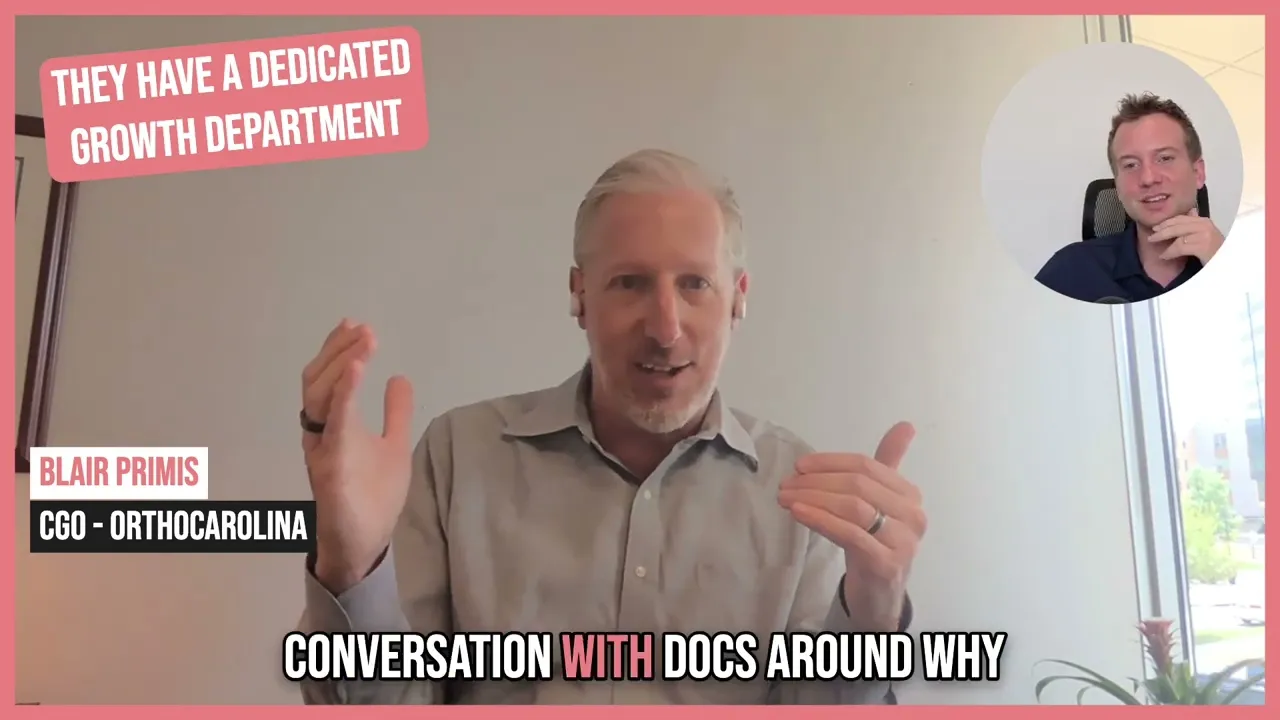
So the heavy lift here — and I love this — was on the relationship management, the change management, creating a behavior shift in physician understanding of what we're supposed to be as a practice and how important it is to be open. And how important it is to be available for patients when they want it, on their time, not when we want them on our time. So the data set just reinforced our effort to do the heavy lift of a behavioral, functional change of how people think about our practice. That was the hard work. The hard work was rolling up your sleeves and having a hallway conversation with docs around why I'm gonna move these slots around.
[00:14:22] Joe: Take me into the room. You mentioned earlier North Carolina, you're really blessed to be in that market, and growth that a lot of people are gonna — why not just ride the wave? If I'm a physician, I see patients coming in, patients are literally moving in, they're gonna come to us.
And so in my experience, there's always this balance of the growth message and the growth in volume, and the juxtaposition of that with the pain of losing out on volume because it went somewhere else. So just take me in the room. What's the pushback that you got? Maybe some things you expected that you were well prepared for, and some things that you weren't, that ultimately maybe it was just relationship and a belief in the overall strategy that got you over the line.
[00:15:07] Blair: Yeah. At the end of the day, any industry will go through this. Any practitioner or subject matter expert or guru or anybody — if you're a pitcher, you wanna pitch your best game, you wanna be set up to be in the best position. Maybe if you're not Ohtani, because he can also bat. But for the most part, they don't wanna be known as being a batter. They wanna be known as being a pitcher.
And I think surgeons wanna do surgery. They went to medical school, they did their residency, they did their fellowship, they wanna be surgeons. And so they wanna cater their schedule to what they believe is the optimal way for them to get surgical volume.
The reality is, in a growth market like we have, anybody can now see. The data's out there. Our competition can just go try and schedule online. There's no secret sauce to what it takes to get an appointment at Ortho. It's public. Give us a call or go online.
Not only do patients experience that, but your competition does. So if we openly show friction, it just invites competition into the market. They'll simply say, "Wow, look at this. 30-day, 45, 50-day, 60-day, 22-day wait at this office? Great. Let's go pop up an office and hire two docs to compete with them." That's the easiest way to do it.
So all I did was say, "Hey, look how easy it is for our competition to schedule. Now let me show you how hard it is to schedule at Ortho. We are inviting the competition to compete with us. Why would we do that?" It makes no sense.
And the torch-bearing comment I would use in many of these meetings with our docs and our staff — I just stole a line I saw. I was lucky enough to see Jerry Seinfeld do a keynote speech, and somebody asked him the question, "Why did you end Seinfeld after nine seasons? You could have gone on forever." And he said, "It was easier to get to the top than it was to stay at the top."
And I tell our docs that. If we're at the top of the food chain — pardon the pun, or pardon the arrogance — when it comes to quality outcomes and when it comes to brand perception, it's harder to stay there. The only way is down. So the reality is we've gotta work even harder to maintain that high level status. Us climbing to the top is a fun joy. You can see the person ahead of you and just pick 'em off. We are up at the top. Don't let them eat away at your market share. Don't let them eat away at your reputation.
We've gotta defend it, and I believe the only way to do that is to be relentless and almost a zealot when it comes to how we grow and how we define our practice. So that, as you can tell just from my enthusiasm, is the ethos we have. That's how we sell it. We sell it as: it's grow or nothing. Stagnation is — no decision is a decision. And so we've gotta go.
[00:17:42] Joe: So speaking about going — where are you going next? What does the future look like, to stay on top, stay aware?
[00:17:50] Blair: Yeah. I think it's this threefold attempt to say, let's continue to be world-class in demand generation, patient experience, and our real estate and access opportunities. How do we best position our practices to be as accessible as possible, be really good at driving demand in those locations, and then manage the best in class experience for our patients?
If we can do all three of those things, I think we're just gonna be a really difficult organization to topple. And patients win, physicians win, teammates and our staff win. That's the vision, that's the goal.
[00:18:26] Joe: As we wrap up here — being in the growth officer position and looking at your experience, what are some of the things you've brought from maybe other roles or other industries that have been really helpful, that have been almost maybe even surprisingly a one-to-one application?
[00:18:45] Blair: Great question. I don't get that question asked very often. It's awesome. And I've got a good one. Go on a journey with me for a couple minutes here, but I spent seven and a half years of my career working for McDonald's. I was in corporate marketing at McDonald's.
It's really where I cut my teeth and learned to be a marketer. If you want to learn how to do world-class marketing, go work at McDonald's. They're spectacular. And what I learned there was that the franchise model of business is really a game of convincing an owner-operator in a local market to believe in the system that McDonald's corporate is creating. And that is directly applicable to a practice owned by physicians.
You have to take a corporate vision — and they hire us to give them our best thinking. They hire us to push back when necessary. They hire us to challenge them. So you have to take and codify that corporate vision and then push it down onto franchisees, whose money you're spending, whose dollars you're using. And that is a direct relationship.
I was working at McDonald's, left, and then came to work at OrthoCarolina, and I used that in my interview 14 years ago. Which is, "You guys don't realize how ready I am for this job, because I've dealt with franchisees." Just like independent physician practice. And so I think find that parallel. Take the drive-throughs out of it, take the Super Bowl and World Cup commercials out of it for a minute, but at the end of the day, they're very much alike. It is a franchise-run business that has a corporate entity behind it, no different than a large practice.
[00:20:21] Joe: That's a great answer.
[00:20:23] Blair: Yeah. Surprising one, I'm sure. But I have that one always rotating, floating around the back of my brain — very similar things that you never really would think they would be. But governance-wise and structure-wise, they're almost identical.
[00:20:34] Joe: And I guess that takes us back to the beginning of the conversation with just the confidence in which you were able to fathom, codify, roll out, and really mobilize essentially the growth department as the central operating aspect of OrthoCarolina. That's fantastic, man.
[00:20:53] Blair: Yeah. I really appreciate it. And like everybody, I've got a wonderful team that has also bought into this vision too. You guys may overlap a bit. My experience teammates may be wandering into a marketing conversation, and the marketing team might be wandering into a real estate conversation, and the ops team is asking the experience team something, and then they punt it to the marketing department.
The interplay of this — where I want them to have black and white roles and black and white responsibilities, but I love when we wander into gray space. Just get in there, knock it around. It's all good. Rely on your teammates, trust your teammates. And if we can do that, somebody will pick up the email, somebody will answer the text message, somebody will address it, and we'll get it figured out and get it solved.
And so I give them a ton of credit for being better at actually articulating this insane vision that I have. But it's been a lot of fun.
[00:21:42] Joe: Blair, thank you so much for your time.
[00:21:45] Blair: Oh, it's my pleasure, man. Good chat. Really good chat.
[00:21:47] Hey, it's Joe. Thanks for listening. If you like what you hear, share with the peer, and if you're looking to scale referral operations to drive growth and efficiency, visit hatchcare.com.