
All Episodes
EPISODE 13
·
·
23:30
Hearing the unheard before turnover shows up
Olivia Wolf
·
Healthcare Executive and Consultant,
Olivia Wolf started in healthcare at 14, posting charges in a hospital billing department, and spent her career in orthopedic practice management. She argues that most practices are running bone on bone — technical skill without the relational skill that holds it together — and explains how to hear the problems that surface long before they reach the turnover report.
LATEST · E-- · —
0:00 / 0:00
Purpose Is the Retention Lever Nobody Manages For
Stop Calling Healthcare an Industry
Top takeaways
1. A lot of practices are running bone on bone
Olivia borrows orthopedic language to describe leadership, and the metaphor does real work. The soft skills — by which she means having hard conversations, not sending email — are the synovial fluid between the joints. Without them you get bone on bone.
Her point isn't that technical skill doesn't matter. It matters to outcomes and to quality. But it has taken the front seat, and the relational half has gone undeveloped, which is what determines whether people can actually thrive inside the operation. Staying in clinical language: culture is where things go to live or die.
2. By the time it shows up in turnover, it has been boiling for a long time
Practices notice culture problems in staff productivity, engagement, turnover and retention. Olivia's warning is that those are symptoms surfacing at the end of a long process — the point where it finally becomes visible or vocal.
What she asks leaders to develop instead is the skill to hear the unheard. The Sunday scaries: how many of your staff are dreading setting out their clothes for tomorrow? Nobody will tell you that. What you'll see is someone arriving five or seven minutes late, then later than that, then calling in sick more often.
Catching it early requires a different kind of relationship. She describes an organization that ran weekly or bi-weekly check-ins — a full hour, including asking whether the dog was okay after the vet visit. The payoff came six months later, when a minor tone shift in a group meeting was enough to tell her someone was struggling, and she had the standing to pull them aside and say, "you're not showing up the way you usually do — help me understand."
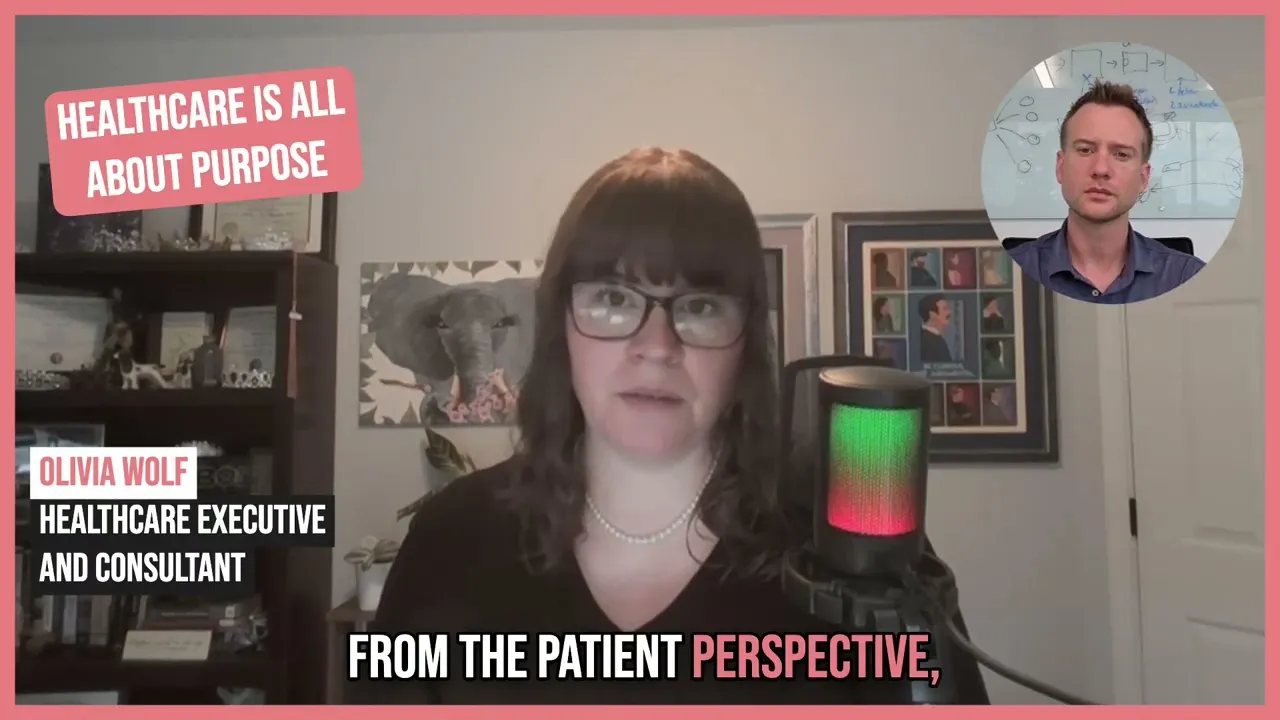
3. Purpose is the retention lever nobody manages for
The burnout conversation focuses on hours, and caps on hours matter — the body can only take so much. But Olivia thinks we discount purpose. Her own experience: a 20-hour job with no purpose left her feeling like she was dying, while purpose makes going above and beyond easy. Healthcare attracts caregivers who are already inclined to go above and beyond, so when that stops, purpose has gone missing.
Some of the drain is structural. She'd been back in the weeds of credentialing for a client and describes a system that feels purposely complicated: CAQH centralizes some of it, but every insurer still requires separate enrollment, and the licensure and disclosure questions are all slightly different. Answering the same questions over and over, just to get a provider paid, is exactly the monotony that makes people ask why they're doing this.
Leaders can't fix credentialing. What they can control is the why — why it matters that the front desk collects a copay correctly, why it matters that revenue cycle gets the authorization ahead of time. The financial answer is well understood. The one that gets skipped is the patient's: they're in pain and they want answers, and the less they have to think about the authorization or the bill, the more their experience is about care.
4. The loud thing in front of you is rarely the actual problem
A surgeon came into her office loud and upset about a cast that came off before the X-ray, which meant a child's fracture fell out. It took roughly 90 minutes to get underneath it, and what was actually there was shame — at having appeared incompetent in front of that family, after all the years of school, fellowship and boards.
The operational failure turned out to be shared. Policy required the provider to specify "X-ray in cast" in the prior note so the tech could follow it; he hadn't. The X-ray tech, finding no instruction in the note, should have double-checked and didn't. Multi-system, multi-person.
What's instructive is how she held both halves at once: real empathy for the shame spiral, and a hard line that shame doesn't entitle anyone to behave however they want, to whomever they want.
The same pattern shows up quieter. A physician complains about how many clicks the EHR takes. Sometimes the configuration really can be fixed. But underneath the clicks is a person who dedicated their life to this profession and is now standing in a hallway fighting software instead of sitting in the room with the patient. The loud thing is distracting, and it's where leaders spend their time.
5. Not all growth is visible — sometimes it's pruning
Asked what foundation healthy growth requires, Olivia's one-word answer is pruning. Standard market logic says growth is always up and out. Nature says otherwise — good crops require a pruning period, and land needs rest.
The practices she's worked with build outward infrastructure — physician recruitment, everything that drives charges and revenue upward — without turning inward to the roots. A tree like that falls over in the first storm. Her actual recommendation to practices in that position: stop recruiting, bulk up revenue cycle, invest in the team, stabilize operations. Recruiting five more orthopedic physicians doesn't help if the support infrastructure isn't growing with them.
She also points at where the money is. Recruitment budgets are large, and that's readily available money — turn it inward. Train staff. Fund the certification for the diamond in the rough. When practices object that a credentialed employee might leave, her response is the uncomfortable question: why would they leave you? What about your culture makes leaving appealing? That part is fixable.
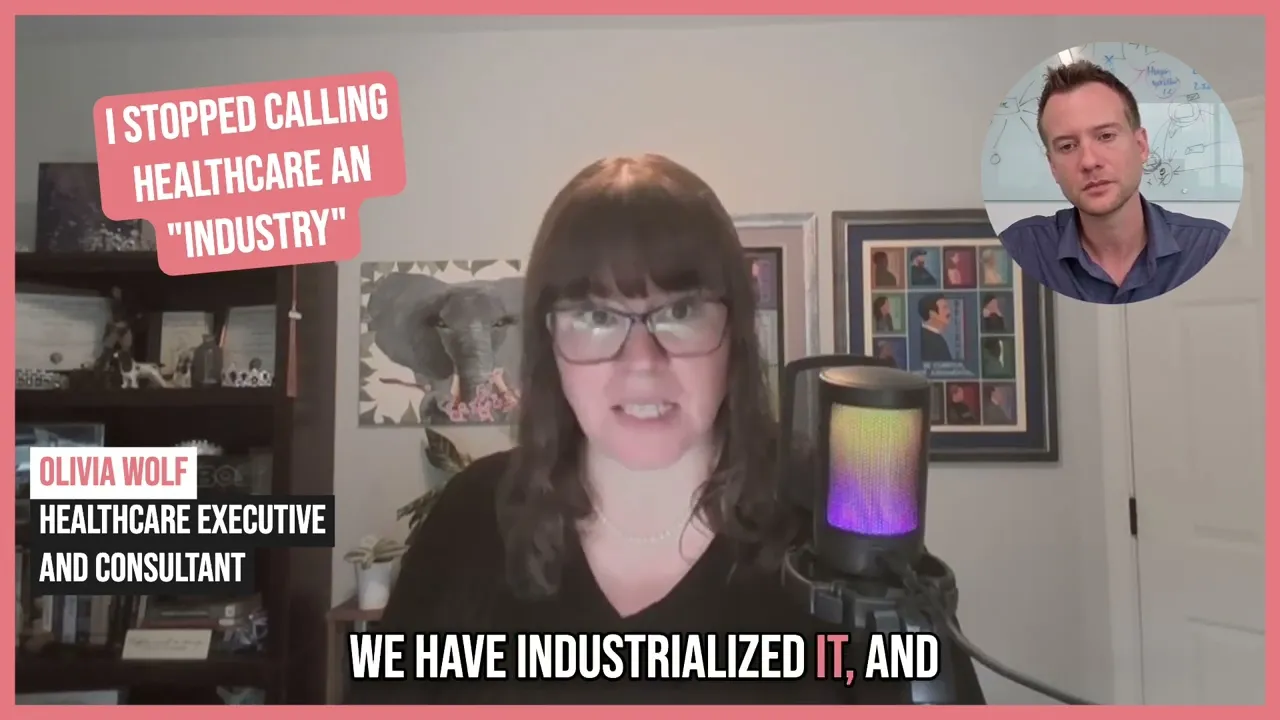
And a related pet peeve, which is where the second clip comes from: she has stopped calling healthcare an industry. It's a humanities profession, and industrializing it is a large part of why it became inhumane — running practices and people like machines when they aren't.
Questions this episode answers
What are the early warning signs of a culture problem in a practice?
Not turnover — by then it has been building for a long time. Olivia Wolf tells leaders to listen for the quiet signals first: staff who dread setting the alarm on Sunday night, someone arriving five or seven minutes late and then later, an uptick in calling in sick, a minor tone shift in a group meeting. Catching those requires knowing your people well enough to notice when they stop showing up as themselves.
Why does purpose matter as much as workload for healthcare burnout?
Because healthcare attracts caregivers who are already willing to go above and beyond — so when that stops, what's usually missing is purpose, not hours. Olivia Wolf's example is that a 20-hour week without purpose felt unbearable, while purposeful work made extra effort easy. Leaders can't fix structural drains like payer-by-payer credentialing, but they can supply the why: what collecting a copay correctly or securing an authorization early actually does for a patient who is in pain and wants answers.
When should a practice stop recruiting and invest inward instead?
When the outward infrastructure is growing and the roots aren't. Olivia Wolf's advice to practices in that position is direct: stop recruiting, bulk up revenue cycle, invest in the team, stabilize operations. Recruiting five more physicians doesn't help if the support infrastructure can't carry them. She also points out that recruitment budgets are large and readily available money — redirect some of it to training and certifications, then fix the culture so those people stay.
Why does calling healthcare an "industry" matter?
Olivia Wolf argues the word is destructive because it licenses the behavior. Healthcare is a humanities profession — a calling — and industrializing it is what made it inhumane, running practices and people like machines. She sees that framing as a real source of friction between physicians, who are largely still in it for the humanities, and administrators applying a standard business model.
Scale referral operations to drive growth and efficiency
Full transcript
Transcript
[00:00:00] And specialty healthcare growth is not optional, but scaling with operational excellence. That's the hard part. I'm Joseph Zboch. This is Scaling Specialty Growth.
[00:00:08] Joe: Thanks for listening. Today's guest is Olivia Wolf, a healthcare executive and consultant. She's a longtime practice administrator who got her start in healthcare at the age of 14, posting charges in a hospital billing department. Olivia has spent her career in orthopedic practice management and served on the board of directors for AAOE.
She's also a certified professional coder, holds an MBA from Creighton, and hosts her own leadership podcast called "The Stuck(ish) Podcast." She's one of the operators who's equally comfortable in the weeds of revenue cycle management and in the bigger conversation about culture, leadership, and what it takes to actually build a practice that runs well.
Olivia, welcome. Thank you for being on the show.
[00:00:48] Liv: Yeah, thanks Joe. I'm happy to be here.
[00:00:50] Joe: I'm really excited to dive into what you've been learning, what you've been uncovering, and what your viewpoints are on culture as it relates to the orthopedic practice. Draw some lines for me about how maybe it hasn't been the focal point that it really needs to be.
[00:01:07] Liv: Sure. Yeah, I appreciate the question. You mentioned I've been in healthcare since I was 14 years old, started out at a hospital. Along the whole of my healthcare leadership journey, a lot of my own focus was just operational, heavy into the technical skills, getting the job done.
Relationships were formed, obviously. The gals that I grew up with in revenue cycle at an internal medicine practice when I first moved to Alaska are still some of my closest friends, and were all in healthcare. But really, the relationships and the work of it were pretty siloed for me in my own mind and my own mental model.
And so as I matured as a leader, really bringing those things together holistically and integrating both what I would call the technical skills and the soft skills of leadership and operations is really where I've discovered a passion. That passion has found a lot of its exercise in things around physician burnout, workforce development, those kinds of things.
And I love orthopedics. I said yesterday to somebody that if it was possible to fall in love with a subspecialty, orthopedics would be it. And part of the reason that I love it is the way that we talk about body and body mechanics in orthopedics. It can be very holistic. And one of the things that I've adopted in my language around the importance of focusing on leadership, not management — operational leadership is a mental model, it's an art, it's a lifestyle — is that some of the soft skills, when we talk about communication, and I don't mean email, I mean having hard conversations, those are all the synovial fluid in between our joints that we need to function properly.
And what I'm finding in a lot of organizations is that we're bone on bone. Technical skills have taken the front seat, and they matter. I'm not saying that technical skills don't matter. They matter to patient outcomes. They matter to quality. And there's a relational and soft skills element that really needs to be developed in leaders to make sure that the culture is creating a place where people can thrive in the operations.
Using medical language again, culture is where things go to live or die. We know that in the lab. That's well-known in medicine. So starting to talk in clinical language about leadership philosophy, I have just discovered a passion for that, and I'm finding that a lot of practices are, especially post-COVID — I mean, there's the larger cultural issue also. A lot of trust has been lost after COVID in relationship to healthcare providers, clinicians, physicians. I think that's why we're seeing a lot of increased violence towards people in the care industry.
So it's a big, heavy seat to sit in, or pool to swim in, if you will. But it's really important, I think more important now than ever, to help regain that public trust, and then the trust inside the practices, to continue to deliver care to patients in a high-quality manner.
[00:04:15] Joe: So you've already given a lot to chew on. Clearly this work is important to you and important in general, and you've brought up a lot of good points. Walk me through some of the early warning signs that the practice body exhibits before there's a fracture — that an operations leader listening to this, that a growth leader listening to this, can diagnose. Before that bone on bone reaches that breaking point, to use some of that language that you've adopted.
[00:04:52] Liv: Yeah, sure. Where I think practices start to see it are in staff productivity, staff engagement, turnover, retention or the lack thereof. What I would say to practice leaders, though, is those are the symptoms that have been boiling for a really long time, and that's where they show up visually or vocally.
Where it shows up — and this would be on leadership to develop just a different kind of relationship with their staff and develop the skill to, what I would say, be able to hear the unheard. So, Sunday scaries. How many of your staff are dreading setting their alarm and setting out their clothes to come to work the next day? They're not gonna tell you that. They're gonna come to work, maybe be five to seven minutes late, maybe later than that, maybe start calling in sick a lot. And so as leaders, it's important to develop a skill to listen for the things that aren't really loud, because it starts way before then.
And I've been in that position myself. When we talk about burnout, like in the physician space, a lot of the conversation has been, well, med schools are putting caps on hours worked now. That's important. The human body is capable of only so much. At the same time, we discount the role of purpose in the workforce, and I can speak for myself, and I've seen it with others.
I have worked a 20-hour job that had no purpose, and I felt like I was dying. You give me a job with purpose behind it, I can easily go above and beyond. And healthcare attracts people who are caregivers, and I think at a baseline willing to go above and beyond. And so when that above and beyond stops, I think we've lost purpose.
And some of the purpose is in the mechanics of it. For example, credentialing. I've been doing credentialing recently for a client. Loathe it. The system is so purposely complicated. There's some centralized things like CAQH where a provider goes in and puts in all their information and other payers look at it, but still separate enrollments for every single insurance company. All of the disclosure questions about licensure and all that stuff are slightly different. So there's no standardization in that.
And so to even get a provider paid, the hoops that you have to jump through for healthy revenue to come in on the back end, to show the work that they're putting in on the front end — because it's a lot of work on the front end. And so it does show up, and that's incredibly frustrating for me to do credentialing in those weeds again. I haven't been in those weeds in quite a while. But it's a reminder that operational systems do lend to that, because it's very monotonous and boring. Like, why am I doing this? Why am I answering the same questions over and over again when they're all in this one place?
And so there is an operational component, and I think that's a misunderstanding at large as well — that the operational technical skills and soft skills are separate. They're not. They really do work together. So there is the operational element that drives lack of purpose. Those things you can't control, though. But there are a lot that leaders can control as far as purpose, like why it matters that the front desk collects a copay correctly, or why it matters that revenue cycle gets the authorization ahead of time.
And we talk a lot about — we know financially why that's important. But from the patient perspective, they're in pain, they want answers. The more that we can do for them to make their experience with our practices mostly about the care and getting them to the healthy place that they wanna be, and not have to worry about the authorization, not have to worry about the bill, that matters. And so those are the kinds of purposes that I think we fail to talk about sometimes, because we're so focused on the health of the practice itself. But it's all connected.
[00:08:58] Joe: So you mentioned the Sunday scaries, you mentioned how to hear the unheard, and some of the symptoms and lower staff productivity. Do you find in the conversations and the work that you do with practice leaders that the source of that is an over-focus on the numbers or the operational aspects of the role? Is that one of many sources? What are the underlying or the fundamental sources that you've uncovered in your work that result in this sort of unhealthy culture at the staff level? And then what does the work to begin to correct that look like?
Is it leaders bringing that to the surface? Is there some sort of framework for acknowledging how things have been run, or what has been communicated verbally or non-verbally in the posture of the practice? Do leaders go first? Is the COO expected to come to work and say, "Man, y'all, I wasn't excited to come into work today, but you know what? I put my head down because I love patients." That's a little glib, I think might be the word, but hopefully you can see the feel that I'm going for here — because this is a soft skill. But I feel like in the work that you've done, you've found ways to harden it, or at least make it more intentional, this kind of cultural healing type process.
[00:10:34] Liv: Yeah, I think it's a multitude of things. I think particularly for small practices — and having been in a small practice myself as an administrator — there's just a lot of work to do. And so it's really easy to get stuck behind your desk, get stuck in your email inbox, and do the things that give us dopamine and also feel like we're doing a good job, which is to complete our task list.
If you're not getting out and listening to your staff — and I'll give you an example. I was in an organization for a while that really focused on the relational element of leaders and staff, and what that looked like was either weekly or bi-weekly check-ins, full hour. What are you up to? And it included things like, "Hey, heard you had to take your dog to the vet. Is she okay?" Really getting to know those people as people.
What that developed is then, six months later, when this person was going through a really hard time, I could tell the way they were speaking in group meetings that something was not okay. Minor tone shift, less bandwidth, more easily irritated, those kinds of things. That allowed me to pull them aside and say, "Hey, I noticed you're not showing up the same way that you usually do," or, "I noticed that you're really struggling to be here on time and that's not like you. Can you help me understand what's going on?" And that just takes listening to and getting to know your people, and we don't provide a lot of time and space for that.
And that leads to the bigger conversation, which is I think we've done a disservice in this country approaching healthcare as a business. We focus too much on the productivity. And not that it doesn't matter — I'm not advocating for the pendulum swing to go the other way into full anarchy where productivity doesn't matter. But in the standard market logic model, healthcare just doesn't work. We run practices and people like machines, and they aren't.
And I think that was a fracture that was there for a really long time, and COVID finally broke it. Workforce has been a challenge ever since. And it was a challenge before, and physician burnout was an issue before, and that greatly compounded it. So there's just far larger implications to the way that we run healthcare in this country that lend to the dehumanization of the model. So that's also a very heavy big thing to bite off and chew and to contemplate, but it really does trickle down into the everyday.
And so back to your point — finding time to get out of your inbox and make rounds, go talk to your people. Just observe what they're doing. And I'm not talking about in the micromanaging, I'm-auditing-your-work way. I'm talking about getting out into the microcosm, the ecosystem of your healthcare practice, and just observing.
Is the doctor continually frustrated about how many clicks in the EHR, when there's actually something in the EHR configuration that could make it two clicks and it would make them feel better? Because you're gonna see the frustration. What's really bothering them could be totally different. They're probably gonna yell about the clicks. What's underneath that is the time of their life that they have dedicated to this profession, and now they're in the hallway trying to get their EHR to work and not in the room with the patient, which is what they want. And so when we talk about purpose, the purpose is taken away when we're taken away from the patient into all these bogged down heavy things.
That in the tech world — love it, it's flashy, it's new, it's shiny, let's do it. Let's move fast and break stuff, which I loathe. I don't think it's healthy in the tech bro sphere, and it's made its way into healthcare and I don't like that either. But just learning to listen for all of those undercurrents instead of the thing that's in front of you, because the thing that's in front of you is gonna be very loud, and it's rarely the actual problem.
Can I share another story around that?
[00:14:34] Joe: Yeah. Yeah, I have a follow-up question or two. Yeah.
[00:14:36] Liv: Dealing with an orthopedic surgeon who ended up in my office loud and brash and upset. Made it about the cast that came off too early — X-ray didn't catch that they weren't supposed to take the cast off before they did the X-rays, so the kid's fracture fell out. Took the time, and it was a good probably 90 minutes, to talk with this physician about what was actually going on, and the bottom line undercurrent was a great sense of shame about appearing incompetent in front of this child's family.
And once we got down to the operations of it, it was part his responsibility, part the X-ray tech's responsibility. In his note prior to this visit, he did not specify X-ray in cast. That was his job. It was in our policies and procedures that the provider specified, so that the X-ray tech could go back to the last note and get their instruction. He didn't do it. Part the X-ray tech, because when the tech looked at the note and didn't see it there, they should have gone and double-checked and asked, and they didn't.
So it was a multi-system, multi-personnel failure. But the thing that caused him to come into my office and absolutely flip out was a sense of shame. Incompetence. He'd been through how many years of school, fellowships, his board period. And so those are the undercurrents that leaders need to start listening to, and then developing the skill on how to handle that. I was fortunate to have developed some skills at that time, and had to have the awkward conversation of, "I know what shame spirals feel like. They suck. I get it. I'm actually with you. And shame does not give you the right to behave however you want, whenever you want, to whomever you want. You don't get to scream at me like that."
[00:16:28] Joe: And this is part of my doctorate work and research. Nobody's prepared for this. We're only prepared for our technical skills.
[00:16:36] Liv: They are only prepared for their clinical technical skills. My cohort are only prepared for the business technical skills, and yet the relationship and the burnout research has been proven to be one of the key drivers of their burnout — which then, you've got an angry, upset, distressed physician. Everybody feels it.
So again, that's a lot of words to say: as practice leaders, developing that skill to listen to the undercurrent and to the heartbeat, and not the symptom that's really loud and in your face, because it's also really distracting, and that's where we spend a lot of our time trying to fix it.
[00:17:12] Joe: Right. And addressing the symptom, not the root cause. So I wanna get your take, for the guests we've had on this show and the listeners of this show — a lot of them are at independent practices that very much have a growth imperative, with the market and the competitive pressures around them. And many of the questions and conversations that I've had are around how do you maintain that kind of operational excellence while also supporting the systems for growth?
And your point of view, what you take of these practices, is very much that you have to develop the skill set to listen deeply, to listen one or two layers underneath, and to be willing to do uncomfortable work. And there's a nice bridge there — Venn diagram or whatever you wanna call it — with uncomfortable work from a relational level, and then uncomfortable work in terms of growth. Growth hurts. Don't I know it. Many a night recently upstairs with my son Remy because his legs hurt.
And so my question is, in these seasons that these operations leaders are going through, they're going to be feeling the pressure to grow. And I've learned in these conversations some great perspectives. Amy Seehafer at OSMS likes to frame this perspective as growth as a game that she and her staff are playing together. Dr. Matthew Slater has invested a lot in the team, and his retention rates are very good. I could go on and on. But I'd like to get your take on the foundational perspective that you feel is required for healthy growth, or regrowth.
[00:19:07] Liv: Pruning. Which also doesn't go in line with the standard market logic, where growth is always up and out and more and more. In addition to looking at the wisdom of our bodies, I tend to look at the wisdom of nature. You want really good crops, there's a pruning period. There's also a period — I mean, if you wanna get super philosophical and biblical about it, once every seven years you're not supposed to grow on a certain piece of property. The land needs time to rest.
And we don't build in rest, we don't build in pruning. A number of practices that I've worked with in the last several years, their outward infrastructure — recruitment of physicians, all the things that make all the charges and the revenue on the front side appear to go up — not turning inward and paying attention to their roots at all. Any kind of storm comes, that tree's gonna fall over. You have to pay attention to your root infrastructure.
And so I have given recommendations to practices: stop your recruiting, bulk up your revenue cycle, invest in your team, stabilize your operations. And again — this is my other pet peeve — I have stopped calling healthcare an industry. That is incredibly destructive language. We are a humanities profession. This is a profession. It's a calling. It's not an industry. We have industrialized it, and that's why it's become so inhumane. We're not dealing with car parts on the assembly line at Ford. But that's how we treat it.
At least in the business office, that's how we treat it, and I think that's a lot of the — I don't think, I know from the research — that's a big part of the problem in the relationship between physicians and administrators or executives writ large. They're largely still in it for the humanities, and we're treating it like a business model.
And so I don't think that practices give enough attention to the time when pruning is supposed to happen. And that doesn't mean you stop, or you stop investing resources. You just turn them inward into your roots. Because it doesn't matter that you recruit five more orthopedic physicians to your practice if you're not beefing up your rev cycle and all of your support infrastructure as you do that. You're gonna find yourself way extended. You're gonna find yourself over your skis, kiddo.
And we see that happening. And then the pressure — and this is where it gets really interesting — the pressure to correct that from a place of the panic that you're feeling is to just keep doing more and more outward. If we just get one more physician, maybe we can get the revenue to bulk up our revenue cycle. No. You gotta stop and learn to make decisions from a place of importance, but not anxiety. And there's a lot of anxiety in the healthcare system. The pressure creates that anxiety, so it's by design.
So it feels very counterintuitive to turn inward. And recruitment budgets are big. I don't know that physician leaders know how big those budgets can be. That's readily available money. Stop sending it outward to recruit. Turn it inward. Train your staff. If you've got a diamond in the rough who would benefit maybe from an extra certification, invest in that, and then fix the culture to keep that person there.
I hear from practices sometimes, "Well, I don't want to invest another credential in my staff. They could leave me and take it elsewhere." Why would they leave you? And that's the uncomfortable conversation. What about your culture makes it appealing to leave? Because you can fix that. So, just very different conversations. And it is uncomfortable to say there's a time to prune, cut back. Not all growth is visible. We know that in nature, we know that in our bodies. Why don't we understand that in business?
[00:22:56] Joe: Taking the time and resource for more inward-facing growth. And that's uncomfortable work. That's going first, that's listening deeply, that's hearing the unheard. Liv, thank you so much for your time on the podcast today. I really appreciate your perspective.
[00:23:13] Liv: Yeah, happy to bring it.
[00:23:15] Joe: Thank you.
[00:23:16] Hey, it's Joe. Thanks for listening. If you like what you hear, share with the peer, and if you're looking to scale referral operations to drive growth and efficiency, visit hatchcare.com.