
All Episodes
EPISODE 12
·
·
22:02
How to keep growing when staff turnover is a given
Jeremy Fournier
·
Director of Operations,
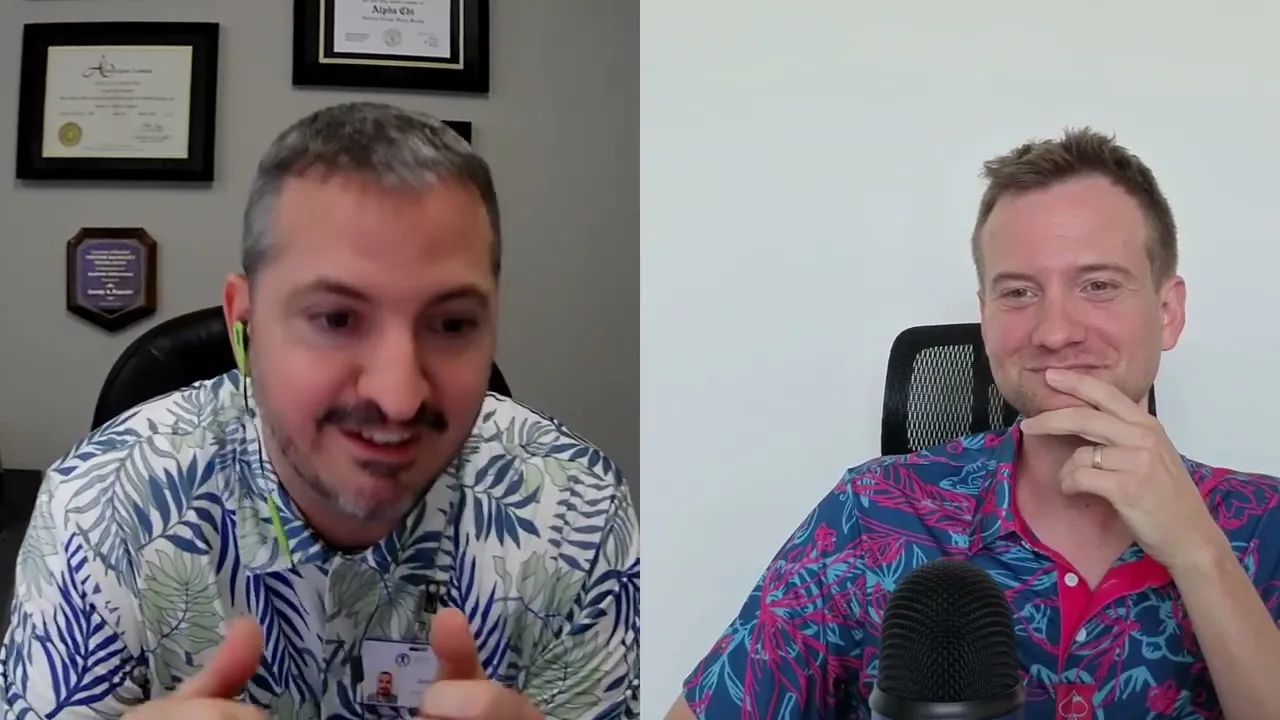
Jeremy Fournier started as an X-ray tech and has spent 19 years at Advanced Orthopedics New England, where he is now director of operations. AONE is a teaching practice, so a share of every cohort leaves for medical or PA school — he explains how to keep growing anyway, and how a group with no ASC and no in-house physical therapy protects the referral relationships it runs on.
LATEST · E-- · —
0:00 / 0:00
Nobody Owns Your Referral Relationships
He Started as an X-Ray Tech. Now He Runs Operations.
Top takeaways
1. When turnover is designed into the model, plan for it instead of fighting it
AONE is a teaching facility — MA students, X-ray students, PA students — and it deliberately hires people who intend to build careers in healthcare. The arithmetic that follows is unavoidable: of roughly 15 MAs, Jeremy estimates about a third are on track for medical school or PA school. Short tenures aren't a failure of retention, they're a consequence of who the practice hires on purpose.
What he's clear-eyed about is where the cost actually lands. It isn't only the vacancy. It's the load on the staff who stay, who are expected to do their own work and train the replacements — which, as he puts it, is no light task and can be exhausting.
The adjustment after a heavy year of turnover was to hire people looking for a career rather than a job, and to teach them what he calls the AONE way. His view of what "advanced" means in the practice's name is worth noting: not the technology, the people — the check-in window, the MA, the X-ray tech, the physicians.
2. If you don't own the ancillaries, relationships are the operation
AONE has no ASC and no in-house physical therapy. It operates in several ASCs and a couple of hospital facilities belonging to different healthcare communities. That structure makes referral relationships the foundation rather than a nice-to-have.
His read on what referrers actually want is refreshingly plain: my patient called, I sent the referral, you saw them quickly, and you told me what the problem was and what the treatment plan looks like. Primary care physicians and therapists want to stay engaged in their patient's care. AONE positions itself as one piece of the puzzle in that patient's life, not the whole of it.
Physical therapy groups in particular want to be part of the process — to know what the physician said in the exam room. So over the past six months Jeremy took over the communication piece himself: PT groups can ask to shadow a physician for a morning, or book a lunch to meet new providers and learn protocols. What does this surgeon want for a patient with a SLAP tear? What should we stay away from? Connecting therapists directly to the PAs and physicians builds the camaraderie he's after.
3. Give referring physicians a number that actually gets answered
The complaint underneath most referral friction is simple: I'm trying to reach you and I can't. AONE's answer was a physician access hotline — a phone number that isn't public, given only to referral sources, that rings directly to one of the scheduling managers. When a primary care physician needs to speak to someone right now, someone is there.
The urgent care sits in the same logic. Three of AONE's four facilities run one, though they bill as specialists rather than as urgent care, because that's what they are. Jeremy prefers to call it convenient care, and describes the two populations it serves: the person who has had knee pain for five years, has the day off, and is driving past the office — and the primary care physician with a patient who has probably just broken an ankle and can skip the old-school route of X-rays first, referral later.
With hospitals it comes down to the same thing, just applied to surgical scheduling: making sure the information is uploaded to the patient's chart so nobody is asking whether a case has to be canceled over a missing H&P.
4. Grow by capturing what you're already sending out
As a mid-size private group — not 50 physicians and 100 APPs — the growth question Jeremy asks is what are we referring out that we could be capturing.
DME was the proof. Everything had been referred out, with AONE paying for the service of fitting patients with braces. When that relationship ended, they looked at the leakage and concluded that with some elbow grease they could run DME in-house, which is what they did.
Pain management is the same play, and the trigger was a new spine surgeon roughly a year into the practice who is doing multi-level fusions — five and six levels — that others in the area aren't. That creates a sharp line between operative and non-operative care. Bringing in pain management, physiatry and neurology would keep referred-out volume in-house while sparing patients the runaround of being sent from one office to the next, trying to remember which doctor they're seeing today.
5. A weekly cadence, and the reports a private EMR makes possible
The leadership team meets every Wednesday, with each leader owning an area: the access manager on call volume and what's being answered versus turned away, the front-end operations manager on no-show and cancellation rates. Patient volume, no-show rates and call volume have been tracked since about 2016 — a spreadsheet deep enough that Jeremy's first reaction on pulling it up was that it's a lot, but a lot of history to mine.
One structural change made the rest possible. On a hospital-owned EMR they couldn't pull the reports or extract the datasets they wanted, because they didn't own the system. On a private EMR they do.
The funnel they watch: how many calls came in, how many became new patient appointments, and how many of those appointments were actually kept. Since adding self-scheduling, they also track how many self-scheduled patients are follow-ups versus new, and how many show — or whether the next available slot was far enough out that the patient found another orthopedic group. They also watch physician availability and third next available, which Jeremy notes is a metric insurers like to pull.
Bonus: his advice for anyone trying to move up in operations
Be a yes person. Jeremy started as an X-ray tech 19 years ago, and the compliment he treasures came from a physician owner who asked him, "How do you care more about this business than I do?"
In practice that meant saying yes to the things he didn't want. He wanted the patient care side — the body, the treatment. Numbers, billing and coding never interested him, and they turned out to be an essential part of leading in healthcare. He still joins calls he has no business being on, on the theory that it's useful either now or in some future role he can't see yet.
He pairs it with an honest caveat: work-home balance is where he has struggled, and nobody asked him to do half of what he does. He does it because he wants to own the process.
Questions this episode answers
How do you grow a practice when staff turnover is predictable?
Plan for it rather than fight it. Advanced Orthopedics New England is a teaching facility that deliberately hires future healthcare professionals — Jeremy Fournier estimates about a third of its medical assistants are on track for medical or PA school. The cost most practices miss isn't the vacancy, it's the load on the staff who stay and have to train replacements on top of their own work. AONE's response was to hire for careers rather than jobs and to formalize how new people are brought up to speed.
What is a physician access hotline, and why does it help referrals?
It's a non-public phone number given only to referral sources that rings directly to a scheduling manager. AONE built one because the most common complaint from referring physicians was simply not being able to reach anyone. When a primary care physician needs to speak to someone right now about a patient they think has a fracture, someone answers — which Jeremy Fournier describes as the thing that actually drives the relationship.
How do you decide which service line to bring in-house?
Look at what you're already sending out. AONE proved the model with DME — everything had been referred out, they measured the leakage, and concluded they could run it in-house. Pain management, physiatry and neurology are the next candidates, prompted by a new spine surgeon doing multi-level fusions, which created a sharp split between operative and non-operative care. The patient-side benefit is avoiding the runaround of being referred from office to office.
What access metrics should a practice review every week?
AONE's leadership team meets weekly and walks the funnel: calls received, how many were answered versus turned away, how many became new patient appointments, and how many of those appointments were kept. Since adding self-scheduling they also split self-scheduled patients into new versus follow-up and track whether long waits sent patients elsewhere. They watch physician availability and third next available, which Jeremy Fournier notes is a metric insurers like to pull. Moving off a hospital-owned EMR to one they control is what made the reporting possible.
Scale referral operations to drive growth and efficiency
Full transcript
Transcript
[00:00:00] And specialty healthcare growth is not optional, but scaling with operational excellence. That's the hard part. I'm Joe Zboch. This is Scaling Specialty Growth.
[00:00:08] Joe: Thanks for listening. Today's guest is Jeremy Fournier, director of operations at Advanced Orthopedics New England, where he spent 19 years. Jeremy started on the clinical side, hands-on with patients, casting fractures, helping people heal, and that's the foundation around how he thinks about operations today.
Jeremy, welcome.
[00:00:26] Jeremy: Glad to be here. Thank you so much.
[00:00:28] Joe: Usually we have a first question that dives right into it, but it's Friday. For people watching the video aspect of this, we've both got on some fun shirts. And so it sounds like AONE is a fun place to work.
[00:00:41] Jeremy: I've been here 19 years. I always say I wouldn't be here as long as I have been if it wasn't. But we do — we try to do our best to make it as comfortable of an environment for our staff as well as our patients coming through.
[00:00:53] Joe: Love that. I mean, 19 years, that's quite a while, and so you know the ins and outs of AONE. Tell me, as you've progressed from the technician side and the hands-on care into operations, director of operations, what kind of perspective has that given you on maintaining that operational excellence while also investing in people, in the process, and the technology needed to hit growth goals?
We'll talk about this a little bit more later, but the next five years at AONE are gonna be a really exciting time in terms of that growth. So tell me about your philosophy. What has shaped it?
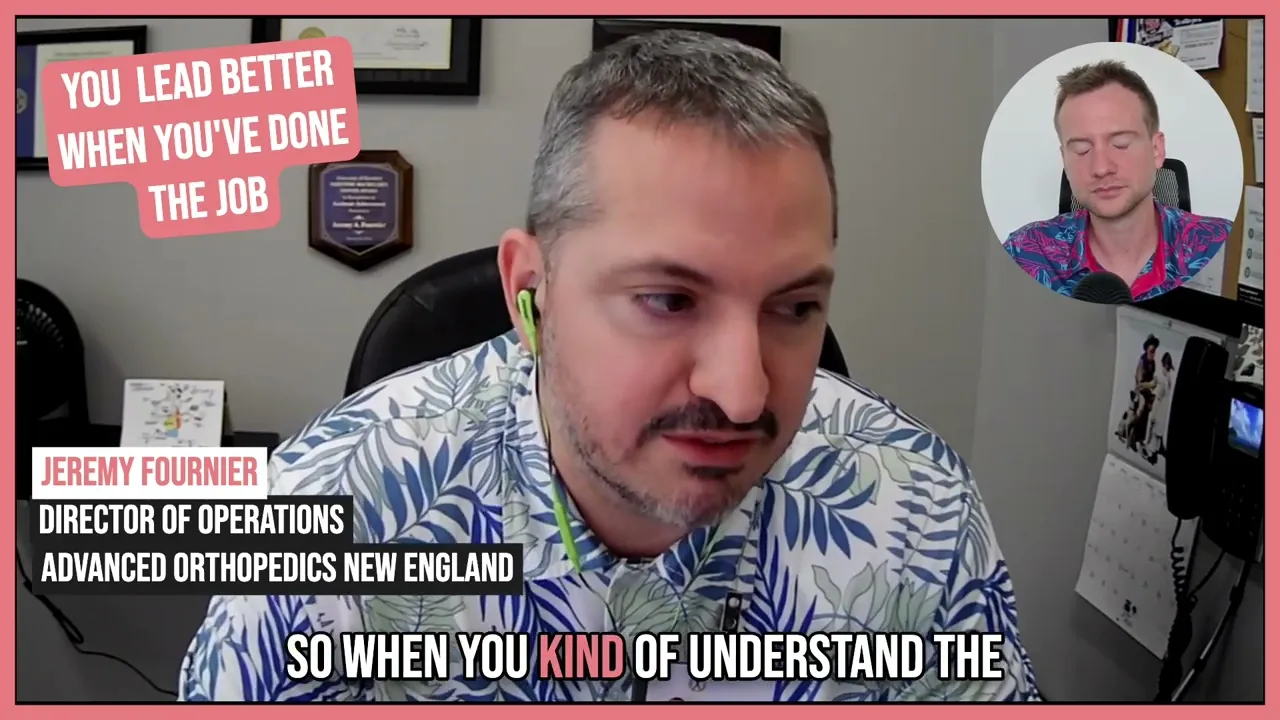
[00:01:30] Jeremy: Yeah. I think that it's important — you know the age-old saying, right? When you've lived the life, you can actually have a little bit more compassion for those doing the work. So that's how I look at it every day. I know it's been a while, and at times I still get asked to jump in on the floor and put on a cast or take an X-ray, which is very exciting for me. Because overall I believe in healthcare, right?
The reason we get into healthcare is because we're helpers by nature. We wanna help people. And so when I get to do hands-on helping, face-to-face with patients, it's always great. But I think it's important to know where you're coming from. So when you understand the struggles that I've had internally — whether it's a busy patient day, or our urgent care gets inundated and you add on 15 to 20 patients that you weren't expecting — really trying to keep that in mind as an operator, to ensure that I'm not losing sight of what the staff is going through day over day.
Every once in a while it's important to throw some extra ice cream sandwiches in the freezer and give a couple attaboys to the team members that are really going through the struggle. What's important for our organization is that patients are coming in pretty acutely. They're coming in, they've been told they need surgery, or they're coming in with a fractured bone and have a really hard time predicting what the next six months of their lives look like. And the last thing they need is to have an operation that they're walking into feel scattered, or frustrated, or overwhelmed.
So we always try to welcome our patients with the idea of — as though you don't wanna hear it — it's a second home for you, and you should feel comfortable in our organization as such. So as an operator, as a past hands-on team member, I think that's what I try to bring into some of the decision-making that we have when it affects those operations.
[00:03:19] Joe: Yeah. As someone familiar with fractures and casts, there's been some operational resetting this past year at AONE. Can you dive into a little bit of the shape of that and some of the things that you've been working hard on, ready for this next phase?
[00:03:36] Jeremy: Yeah, sure. Just like any organization, one of the things we pride ourselves on is, one, we're a teaching facility, so we have students — whether they're MA students, X-ray students, we have PA students coming in. So one of the things we like to do is hire healthcare professionals, or those that believe that they're gonna be in the profession in the future.
So if I were to do a tally count, if we had 15 MAs, I would say probably a third of those MAs are on a track to either go to med school or PA school in the future. So we know we have short lifespans with some of our team members that are coming in, because we know that they're gaining some experience, getting some of that hands-on.
And just as it happened in the past year, we had quite a few turnovers due to folks either going back to school or other opportunities that would lead to some professional development for team members. So as we struggle to get through the shifting of hiring new team members on and the training process, we also understand that puts a heavy load onto our current staffing, our current team members that are expected to do the work on top of training — which, if anybody's ever trained anybody, you know it's no light task. And it can be quite exhausting at times.
So the hope is that we're at this point now where we feel that we've hired some true healthcare professionals, people that are looking not for a job, but for a career, and really bringing them on board, teaching them what we call the AONE way. I always say we're Advanced Orthopedics, and it's not a cool name that starts with an A and puts it at the top of the list for search categories. But I do believe we're advanced in our care. And I think that advancement is mostly through our people — the staff that you're seeing at the check-in window, or the MA that's bringing you back, or the X-ray tech taking the pictures, or the physicians doing the work. I believe that's what makes us advanced.
[00:05:29] Joe: Yeah. Across the conversations that I've had with operational leaders, a consistent theme that I've come to is that the people are the foundation that's most important. And it sounds like you have a really healthy perspective in terms of, folks aren't necessarily gonna spend their entire career with us. We're going to invest in them anyway, and we're going to plan for there being some amount of turnover, whether from the clinical side or the front desk side, to really maintain that experience for the patients while also recognizing the truth of the nature of the business.
There's been a leadership change recently and a focus on the strategic relationships that you guys have across the market. One of the interesting things that we learned earlier when we were just chit-chatting was, AONE — you don't have an ASC, you don't have PT in-house, you have an urgent care. And so strategic relationships, making sure that you've diversified these referral streams and that you're investing not just in the people, which we've covered, but also making sure that the relationships are really fortified and strengthened. Can you dive into that a little bit, where your focus area is from an operational standpoint?
[00:06:39] Jeremy: Yeah, for sure. So as you mentioned, our relationships are really the foundation of what keeps the operations going. We need the patients in the door to be able to keep our operations running. So we operate at a few different ASCs. We find ourselves in a couple different hospital facilities that are part of different healthcare communities, if you will. So being able to keep those relationships open — our physical therapy relationships, our primary care doctors that we try to engage with as often as we can.
Most referral sources, really what they wanna hear is that my patient called, I sent the referral over, you got him in in a short time, and you then produced results of what you thought the problem was, what problem was happening for this patient, and what the treatment plan really looked like. So that these primary care doctors or physical therapy, they feel very much engaged in the treatment of their patients, which is very important. So we kind of consider ourselves as just a piece of the puzzle in the patient's life.
So being able to maintain those relationships is an area of focus that we're gonna be looking into more in the next year or two, where we can continue to find ways to engage with our peers and make sure that those relationships don't run stale, and that they understand we're here to help should their patient population need us.
[00:08:05] Joe: Yeah. What can you share about what some of those efforts might look like in terms of strengthening those? Is it liaisons? Is it a technology component? The things on the whiteboard in the conference room. What are some of those?
[00:08:20] Jeremy: I mean, you kind of nailed it. One of the big things that we found — I'll use physical therapy as an example. One of the things that I found about physical therapy groups and physical therapists in general is that they just want to be a part of the process. So they wanna understand what the physician's talking to the patient about in the exam room.
So one of the things that I've tried to do in the past six months or so is really take over the communication piece. So physical therapy groups can reach out to me and say, "Hey, do you have any time that we can come in and shadow your physician for the morning?" Or, "Hey, just wanna meet some of the new team members — can we schedule a meeting through the lunch hour so we can get in front of your providers here, so we can talk about what their protocols are? What do they like for their patients when they're coming in with a SLAP tear? What is it that they want us to do? What do you want us to stay away from?"
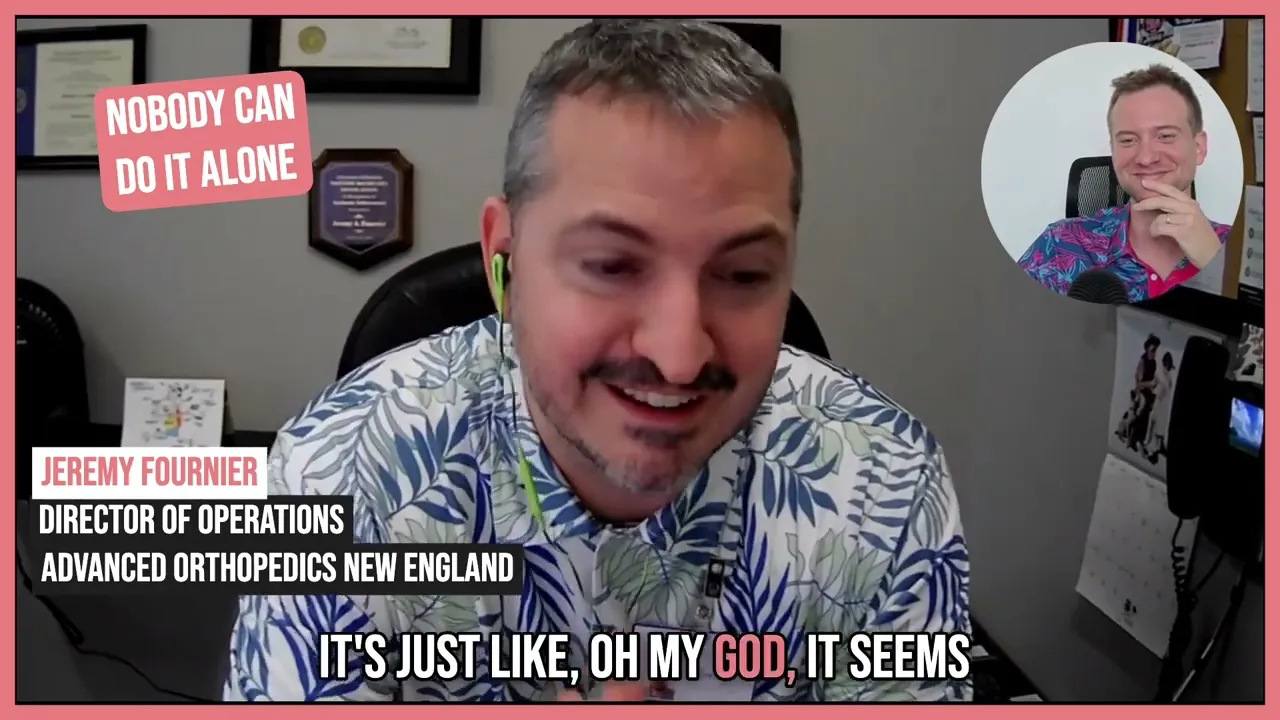
So really connecting physical therapists with the PAs and physicians that we work with is an important piece, because then they build this camaraderie of teamwork mentality, which I'm a big fan of. There's some things that came out of COVID that I can't stand — some of the sayings like, we're all in this together — and it's just like, oh my God, it seems so played out, because it was so important to talk that way, especially during the height of that stuff. But I do believe that some of those cliches are just so very true. Nobody can do it alone. We can be the best orthopedic practice on the earth, but if we don't have good support teams, good referral sources, and good people helping us deliver the care for these patients, I think that's what really builds it. So we are a team. There's no I in team — all the cliches that you wanna use. I guess that's where I stand.
[00:10:02] Joe: How does the work you're doing investing in local PT relationships contrast with physician practices and then hospital networks? Do they have different flavors? Do they have different strategic approaches or outcomes or expectations on the other side? How does that relationship change, and how do you change how you support it?
[00:10:27] Jeremy: Yeah. Like I said, with the physical therapy groups, they're really looking for hands-on development relationships. Just today, we have an occupational therapy student following one of our hand surgeons, that came from a physical therapy group. She's a student over there through the group, and they said, "Hey, would you guys mind if this student came and followed your orthopedic surgeon around for a morning?" And look, these are all the people that are gonna be taking care of all of us as we age. So I think there are no secrets when it comes to healthcare. You wanna divulge all the knowledge that you have, and our physicians are committed to that, which I think is great.
As far as the primary care relationship building and what that looks like for engagement, I think really what they're looking for is open lines of communication. I'm trying to call you because I think that my patient might have a fracture, and yet I can't get in touch with you guys. How do I get in touch with you? So we've gone through different hotlines. We've actually created a physician access hotline, as we call it. So we have a phone number. Nobody else has that number. It's not public, but we give it to all of our referral sources. So when that primary care is like, "I need to speak to somebody right now," that phone rings directly to one of our scheduling managers, and they're able to assist right away. So being able to offer and deliver access points for primary cares is really what drives that relationship.
Hence why we opened an urgent care. We have four facilities, three of them have urgent cares. But we don't bill as urgent care — we bill as specialists, 'cause that's what we are. And I always say, it's really convenient care. It's, I've had knee pain for the past five years, and I have the day off, and I'm driving by your office, so guess what? Today's the day I'm taking care of my knee pain. Versus, I have a patient in my office that I think just broke their ankle — can I send them over to you instead of getting X-rays and then going through the old school process?
So specialty urgent care, I think, is another great resource for our primary care groups that have been using us quite a bit, which is very exciting. And then as far as the hospital's concerned, it's the same thing. It's just the communication piece, and really being able to make sure that when you're scheduling surgeries, they have the information they need. It's uploaded into the patient's chart, so nobody's questioning whether or not a surgery needs to get canceled because there's no H&P uploaded into the system. So really maintaining open lines of communication, I think, is the old school but tried and true method of maintaining relationships.
[00:12:55] Joe: From a growth perspective, what seems to be the most promising referral streams or investments that you're making, where operationally you need to make sure that you guys are ready for it? I know in our previous conversation you mentioned pain management as coming up on the radar. Obviously urgent care can be a great, quite literal foot traffic. How are you thinking about those different bets and operationally supporting those?
[00:13:24] Jeremy: Yeah. I think as a private organization, I would call us mid-size. We're not a very large group. We don't have 50 physicians and 100 APPs. So as a mid-size, as we're looking to grow, it's really looking at what area of growth are we interested in, and what are we sending out that we could start capturing.
Historically, we found that with our DME program. We had a DME program in which everything was straight referral out. We paid for the service, for folks to come in and treat our patients as far as putting on braces and so forth. And then as that relationship was ending, we realized that with a little bit of work and a little bit of elbow grease, we could create our own in-house DME program. So that's what we looked at. We saw a ton of leakage through DME, so we found that as an orthopedic office, it would be very wise of us to try to maintain that in-house.
So that's where pain management comes in. We just got a new spine surgeon — he's a couple weeks away from being a full year with our practice. Amazing individual, and he is doing surgeries in the area that no other spine surgeons in our area are really doing. So if it's a two-level fusion, he's kind of skipping over some of those, because he's really doing the multi-level fusions, five, six-level fusion. So as he came into the practice, there's a very clear distinction between operative and non-operative care.
So as we start thinking of pain management, physiatry, and looking at our physical space — how can we grow our physical space, and then also as we're growing, incorporate some of the ideas and what we need. So a pain management physician coming in, physiatry coming in, neurology coming in, gives us the opportunity to keep some of the stuff we refer out in-house, which will help with our strategic growth, as well as give the patients an outlet where you're not gonna come to us and get referred to go over there, and then get referred to go over there.
If we can find ourselves in a position where we're a one-stop shop for our patients — ultimately that's the main goal, being able to provide that care for the patients so they feel that they don't have to do the runaround and get referred out to every other business in the area, and try to remember which doctor they're seeing today.
[00:15:38] Joe: Yeah. That's great. I've seen it in other businesses where you see customers come in and you identify where the gaps are, and then you're choosing, all right, where do we want to invest to bring this in-house? And it sounds like you take a very methodical approach.
Tell me a little bit about the data side of things. You said, at least when it came to DME, you saw quite a bit of leakage there. What tracking do you have in place to really get an operational pulse on how a patient moves through the practice, so that you can then take this to your counterparts and say, "Hey, pain management might be a thing"? Although that sounds in large part where that spine physician really is like, "Hey, I'm bringing in a lot of this. This would be a great complementary type service." So tell me about the data story, how you find out which of these areas you wanna go into next.
[00:16:33] Jeremy: Yeah. I'm very fortunate to work under somebody that really likes to focus on the data. Our executive director for the group, his name's Brian Hayes. He does an amazing job of really creating a leadership team in which everybody has a certain area of focus.
So our access manager is really looking at how many phone calls are coming in, how many of those phone calls are getting turned away, what are we answering, what are we not answering. We have our front-end operations manager who is tracking a lot of the no-show rates and cancellation rates. We have systems in place.
We use a private EMR. We used to be on a hospital system, which made it really hard for us to pull reports and get certain datasets out of that EMR, because we didn't own it. But now that we have ourselves in a private EMR, we have complete control over our space, and that's generally where we go to first.
How many calls did we get? How many resulted in new patient appointments? And out of those new patient appointments, how many actually kept their appointments? We've recently upgraded our registration system so that now people can self-schedule, so really monitoring that. And out of the people that self-schedule, how many are follow-ups versus how many are new patients? Out of those patients that self-schedule, how many actually come in for their appointments? Or did they maybe get an appointment that was too many days out and so they found another orthopedic group to work with?
So our leadership team meets every Wednesday. We break it down. We've been tracking our patient volume, no-show rates, our call volume — since about 2016, we've been keeping track on that. So it's great that, as I mentioned, Brian Hayes came to our organization a little over a year and a half ago. Day one, I pulled that spreadsheet up and was like, "It's a lot." But know that there's a lot of history here, and a lot of information that we can really start picking out, to find areas that we're hurting.
So we track the availability of our physicians — so who can get in tomorrow, third next available, 'cause that's a big point of access for insurance companies to wanna pull. So as a very general kind of understanding, there's some manual work that goes into it, but we keep an eye on these things every single week.
[00:18:54] Joe: As we reach the end of our time here, I'm really curious, from an advice perspective, what would you tell someone that is looking to move up in operations? And the reason I'm so interested in your answer is, thinking back to the beginning of the conversation, just how very intentional AONE is with investing in people. So I feel like you guys have a really interesting approach, and maybe you've got some nuggets of advice for some up-and-comers.
[00:19:22] Jeremy: Yeah, sure. As you mentioned in the beginning, I started off here 19 years ago as an X-ray tech. I always say I'm a yes person. So I think anybody that's looking to do more — I actually had a physician come to me years ago now, but said, "Jeremy, you understand that I own this business." And I said, "I absolutely understand that." And he said to me, "How do you care more about this business than I do?" And I thought that was just the biggest compliment anybody could ever give me, right? 'Cause I am very passionate.
So anybody that really is looking to grow within their organization or their career field, it's really more than just saying what you wanna do and getting a degree to match what you think you wanna do. It's really investing your whole self into living, breathing the processes that you wanna put in place.
So I always say being a yes person — there were certain things they said yes to that I didn't wanna say yes to. "Hey, would you like to learn the financial..." No. No, I really don't. I wanna learn the patient care side. I wanna learn more about the human body, and the growth, and the treatment of our patients. Numbers, billing, coding, all of that never really interested me. But it's a very important piece of being a leader in healthcare.
So I'll always say yes. I join calls on a regular that I have no business being on. But I look at it as an opportunity for me to grow internally. So whether or not it's gonna be beneficial to me in my day-to-day life, or whether it's gonna be beneficial to me maybe in a future part of my life that I don't even know exists yet.
In our organization, what I've tried to do, and what we try to foster, is anybody that's looking for development and looking for growth — I think it's a fine balance of being able to commit yourself to the organization, but also find the ability to turn off and find that work-home life balance. 'Cause that's an area that I probably struggled in. I think if you asked my wife, she might agree with you at times, where it's like, "What are you doing? Do they want you to work this weekend?" And it's like, "No, nobody's asked me to do half of the things I do. I just do it because I wanna own the process. I wanna be here, and I wanna be a rock star for our physicians and for our patients, most importantly."
[00:21:39] Joe: Jeremy, thank you so much for saying yes to the podcast.
[00:21:43] Jeremy: Absolutely. Thanks for the invite. Happy to be here.
[00:21:47] Hey, it's Joe. Thanks for listening. If you like what you hear, share with the peer, and if you're looking to scale referral operations to drive growth and efficiency, visit hatchcare.com.