
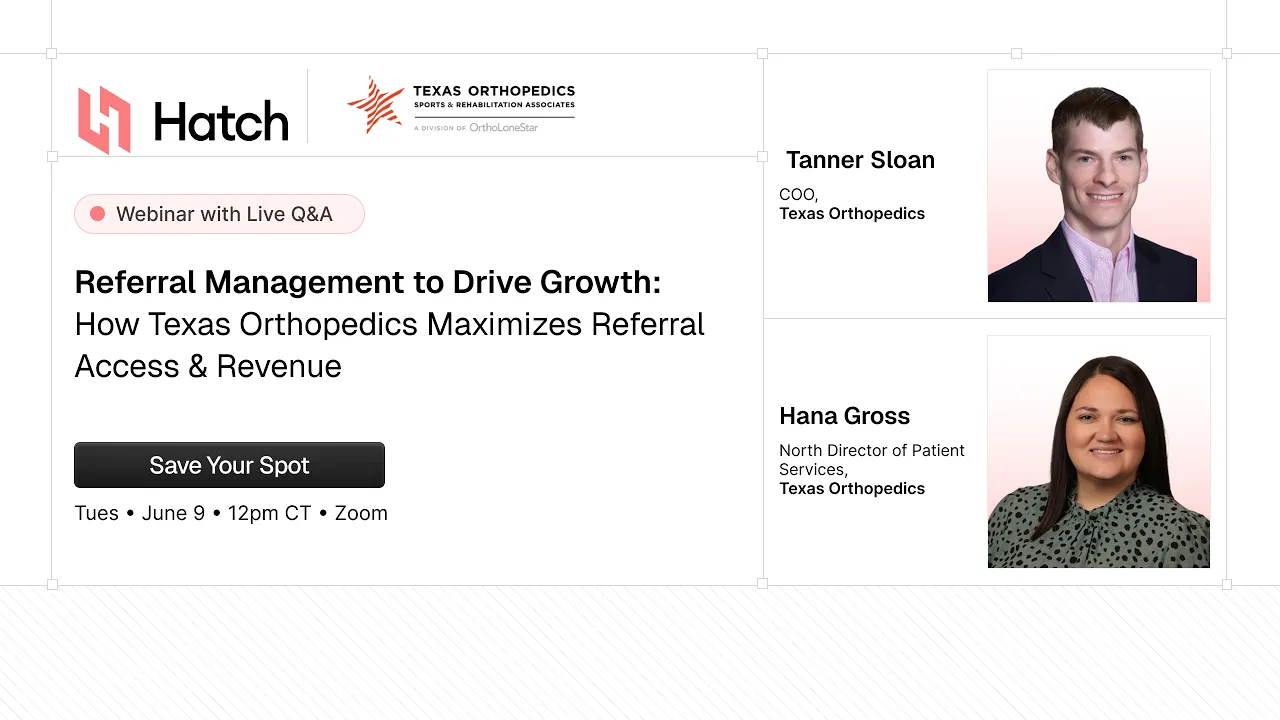
A referral is not a guaranteed visit. In a market like Austin, where more than two dozen orthopedic groups compete for the same patients and primary care practices are steadily being absorbed by hospital systems, the hours between a referral arriving and a patient hearing back often decide whether that patient is kept or lost. On June 9, Tanner Sloan, COO of Texas Orthopedics, and Hana Gross, the group's North Director of Patient Services, joined us to walk through how they run a centralized referral team at scale on Athena.
Key takeaways
In a consolidating market, how fast the team responds to a referral is how Texas Orthopedics defends the referring-physician relationships it depends on.
The group runs a single centralized referral queue on Athena, supported by custom practice roles and a twice-daily manual accountability log.
The hardest gaps are not effort, they are visibility, because Athena cannot cleanly show whether a referral was actually worked.
Without clean data, the group cannot build a productivity-based bonus structure for its referral team, which became part of the case for investing in purpose-built technology.
In a consolidating market, the referral experience is how independent groups compete
Texas Orthopedics is one of the largest independent groups in the state, with 39 physicians across seven Austin locations, a multi-subspecialty footprint that includes spine, trauma, and rheumatology, and its own MRI, physical therapy, ASC, and infusion services. It is also one of seven divisions of OrthoLoneStar. Being the largest group in the area does not insulate it from the competition, and Tanner was direct about why the referral relationships independent specialty groups rely on are under pressure as the primary care physicians who send those referrals are absorbed by hospital systems. "We have to fight harder now more than ever to make sure that we are maintaining and fostering those relationships," he said.
That pressure sets the standard the team holds itself to. Every patient should be contacted within four hours of a referral arriving, and in no case should a patient go longer than 24 hours, because beyond that the patient has often already gone elsewhere. When a referral does slip, the cost is rarely just a missed appointment.
"A little bit of your soul dies, because you know we lost out."
That was how Tanner described the moment a physician asks why a patient they sent never showed. The damage carries downstream and upstream at once. Patients, in his words, are "very vocal on social media or Google reviews, and so they're quick to chastise us if it took too long for us to reach out to them," and they carry that frustration back to the referring physician. Referral management, at this point, is reputation management.
How Texas Orthopedics runs a centralized referral team on Athena
Texas Orthopedics centralized its contact center about fifteen years ago and pulled its referral coordinators into a dedicated centralized team within the last four or five, building what Tanner described as a group of subject-matter experts who understand each physician's requirements. Hana oversees that team and the day-to-day work of getting patients scheduled with the right provider as quickly as possible. The rigor they have built on top of Athena comes down to a handful of deliberate choices:
A single service-center bucket holds every inbound referral, so coordinators work one queue instead of hunting across location buckets. As Hana put it, "instead of having to search through a bunch of different location buckets and different items, we just have the one."
Custom practice roles and task-assignment overrides route referrals to the team and track follow-up attempts separately, a configuration Tanner called the point where "we feel like we've leveraged Athena's functionality to the max."
A dedicated follow-up status moves a referral into a second outreach attempt after a voicemail is left, before it is closed out.
Capturing the referring physician in the insurance package keeps that attribution tied to the patient, so the visit note routes back to the referrer and the loop closes.
Twice a day, the team manually counts outstanding referrals and the oldest open date and charts it to track lag time and volume. "It gives us a graph," Hana said, one she uses to move coordinators toward whichever queue is backing up.
Every one of those workarounds exists for the same reason, so a patient is contacted quickly and the physician who made the referral hears back.
The people, process, and technology gaps that still cap efficiency and growth
Even with that structure in place, the gaps are the part that keeps the team up at night. Hana runs through the same questions every day without a clean way to answer them. "How many referrals came in today? How many were worked? How many patients are contacted? What's our lag time? Where are referrals aging?" The constraints behind those questions show up in a few places:
Visibility is the first gap. Athena can show that a referral was touched, but not whether it was worked. As Tanner put it, "we can report on if they touched it, but we don't know if they actually worked it."
Building a new patient chart across two screens takes at least three to five minutes, often on referrals where the patient has already scheduled and the work turns out to be redundant.
Referrals still arrive through scattered inputs, by fax, by clinical document, and by email, which pulls the team's attention in different directions.
Because the underlying data cannot be pulled cleanly, the referral team has no reliable productivity metrics, and the group has struggled to build the incentive structure its other teams already have.
That last point is the one that compounds. With trustworthy data, Tanner explained, "we can take that with true productivity metrics and create a KPI program to bonus them," which he tied directly to staff retention and recruiting. The hours the team spends counting buckets are hours not spent on patients and referring providers.
Competing on the referral experience meant investing in purpose-built technology
Texas Orthopedics made a deliberate decision to compete on the referral experience and brought on Hatch to close those gaps. The team is looking to consolidate its inputs into a single work order worked first-in, first-out, automate the chart creation and the communication back to referring providers that gets dropped today, and capture the referring physician automatically as a backstop when an insurance correction would otherwise lose it. Tanner framed the shift in his own terms.
"I would equate this to dumping the bicycle that we are riding that requires so much energy and effort to get up to the top of the hill when we're constantly sliding backwards, to moving into a vehicle that has, like, the lane assist, some of the self-driving components, and all we're doing is taking the power, harnessing that, and just steering it accordingly."
The outcomes they expect ladder back to patients and referrers first. Faster response should lift conversion and bring lag time down, the communication back to referring providers should strengthen those relationships, and the coordinators get their time redirected toward work that helps patients rather than monitoring buckets. It also means Hana stops spending part of every day building an accountability log by hand.
As part of the rollout, Texas Orthopedics is establishing a referral data baseline, the kind of view that is near impossible to pull cleanly from Athena today. Hatch is making that same Referral Data Baseline Report available to Athena orthopedic groups at no cost. If you want to see where your referrals are aging and what your true conversion looks like, reach out and we will set one up.



Workers' Comp Referrals: How Orthopedic Groups Compete on Experience
Joe Zboch
What it takes to win workers' comp referrals and keep referral partners as volume grows. Recap of Hatch's panel with OrthoLoneStar, ABJ, and DMOS.

The Success Metrics of Modern Referral Management
Joe Zboch
Activity metrics show whether your referral team is busy. See how a modern referral management scorecard also measures access, relationships, and growth.
The Top 7 Orthopaedic Conferences to Attend in 2026
Your guide to the meetings that matter for surgeons, practice leaders, and orthopaedic operators

Why Workers' Comp Referrals Break Down in Specialty Care
Workers' compensation referrals rarely break down at a single point. The strain accumulates as specialty groups coordinate communication across employers, adjusters, physicians, nurse case managers, attorneys, and internal staff, and that coordination burden falls hardest on the injured worker waiting for timely access to care.