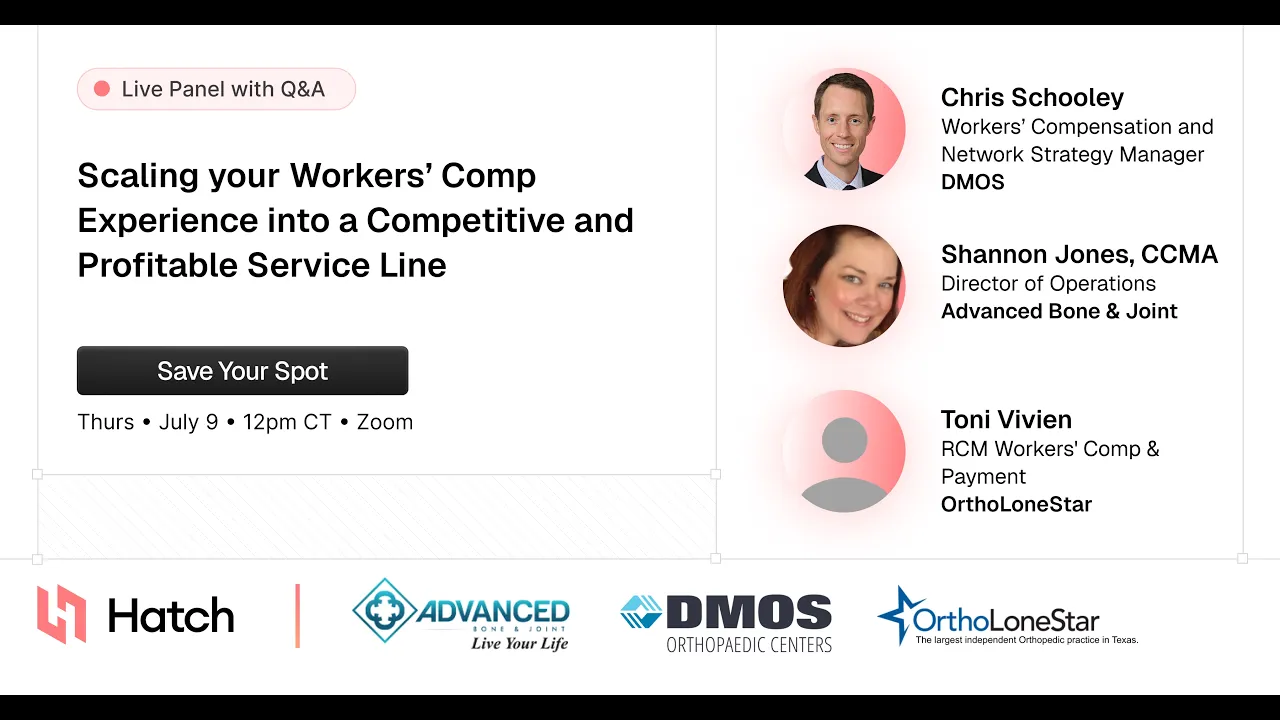
Three orthopedic groups of very different sizes sat on the same panel and arrived at the same conclusion about workers' comp.
Toni Vivien leads the centralized workers' comp team at OrthoLoneStar, an MSO processing referrals from national partners like Concentra and CareNow. Shannon Jones runs workers' comp at ABJ, a community orthopedic group. Chris Schooley is network strategy and workers' comp manager at DMOS, hired to grow the service line in a competitive market. Over forty minutes of questions, the three described the same dynamics from three different vantage points.
The referral source is not the patient
A commercial patient chooses a group once. A workers' comp partner chooses repeatedly, and each referral is evaluated by several parties at once. Toni counted the stakeholders attached to a single case, from the employer and adjuster through the nurse case manager, provider, scheduler, and therapist.
"As our volume grows, the first thing that gets strained really isn't billing. It's really about communication and coordination," she said. "Every referral involves multiple stakeholders, and as volume increases, every breakdown in communication becomes magnified."
That is the structural difference between workers' comp and the rest of the referral mix. The referral decision sits with a professional who manages dozens of open cases, compares groups regularly, and works alongside other referral sources doing the same.
Your partners have somewhere else to go
Shannon described why the relationship has to be earned continuously. Adjusters and employers are not captive, and their priorities are concrete.
"There are so many other potential physicians that they could go to," she said. "The adjusters and the employers want to get the injured employee back to work as soon as possible, and it boils down to time."
Each day of delay carries a cost for the employer and for the adjuster managing the claim, so speed and communication operate as selection criteria, not courtesies.
One bad experience outweighs a hundred good ones
Toni's observation set the frame for much of the discussion.
"Our referral partners rarely remember the hundreds of referrals that went smoothly, but they remember the one patient that wasn't contacted properly, or their surgery wasn't approved and it caused a delay."
Shannon described the consequence in the terms her partners would use. "If you are slow and cannot communicate, you are on the blacklist, if you will."
Both were pointing at the same asymmetry. Trust in this service line accumulates over hundreds of routine referrals and can be damaged by a single one, and because adjusters and employers work in networks, the damage rarely stays contained to one relationship.
The winning group is the easiest to do business with, every time
Taken together, those conditions explain why every panelist, unprompted, described competition in workers' comp in terms of experience rather than clinical capability, which partners largely take as given.
"We want our external partners, adjusters, employers, nurse case managers, to have a similar experience that's consistent, that they know what to expect when they give us the privilege of taking care of their employee," Chris said.
Toni holds the same standard across an entire MSO. "Our goal is to make it easy to do business with, and our referral partners know that they can send a patient anywhere within our organization and receive the same high level of service and communication."
The word all three kept returning to was consistency, meaning the same experience on every referral, at every location, from every physician.
Consistency at volume takes infrastructure, not effort
A small team can hold that standard through attention alone. Each panelist described the point at which growth made that impossible, and what they built in response.
At DMOS, the pattern before was familiar. "Our coordinators were kind of just going every which direction," Chris said. "You'd get an email, and now they're going that direction. Then something else comes in, and it's difficult to prioritize when that's the flow of information." The group added a workers' comp portal, the single investment its external partners had asked for most. "The biggest change for us is not so much all the changes and processes that we have to adapt to having a portal. It just is a simpler process for our external partners."
OrthoLoneStar's version of the problem was standardization. "Every single division had their own work comp department or team, and they were all doing things very differently," Toni said. "We had to take bits and pieces of what all those divisions were doing, evaluate it, and form our own standardized process."
ABJ centralized. One coordinator now directs every workers' comp case so partners have, in Shannon's words, "that right hand with them along the ride," and the team replaced its spreadsheets with a single place to track every referral.
The specifics differ, but the underlying move is the same. Each group converted partner experience from something individual staff maintained into a property of the process itself.
You can't keep partners you can't see
The metrics discussion produced the panel's most candid exchange.
"Prior to Hatch, I was not able to tell you how many referrals we had gotten from Concentra or from CareNow," Toni said. "Now I will be able to see if our CareNow referrals have dropped off, or if they have increased."
Shannon reported the same gap. "We did not have a great way to measure the referral sources. You don't know what you don't know, right? And now we have a clear, better view and a way to track that."
Chris described how DMOS uses that visibility. "Who are we receiving referrals from consistently? Who's the nurse case manager on some of those? What haven't we received from some of those that we were getting a lot from? What happened there?" His team follows up on those answers directly, he said, to mend fences or to build on what is working.
A point raised during the discussion is that referral streams are not permanent. They respond to experience, competition, and consolidation, and a source that goes quiet rarely announces it. The groups that keep their partners are the ones in a position to notice.
Open to everything, attached to nothing
Chris closed with the operating mindset behind all of it. "Change is inevitable. You've got to be open to everything and attached to nothing, because as we grow and progress with not only volumes but different processes, things are just going to continually change."
For groups building or growing a workers' comp service line, the panel's conclusion is practical. Partner experience is the competitive variable, it degrades under volume unless it is engineered, and the data to protect it has to exist before it is needed.
The Hatch workers' comp offer
The capabilities the panelists described, the partner portal, the centralized referral queue, and source-level reporting, are what Hatch builds for workers' comp teams. Qualifying groups can start with a no-cost trial and run it against their own referral volume.
Drop us a line to ask whether your group qualifies.
Watch the full conversation here:
Transcript



Referral Management on Athena: How Texas Orthopedics Drives Growth and Access
Joe Zboch
One of Texas's largest independent orthopedic groups runs thousands of referrals a month on Athena. Tanner Sloan and Hana Gross break down the centralized team they built, the gaps that configuration alone could not close, and why they invested in purpose-built referral technology.

The Success Metrics of Modern Referral Management
Joe Zboch
Activity metrics show whether your referral team is busy. See how a modern referral management scorecard also measures access, relationships, and growth.

The Top 7 Orthopaedic Conferences to Attend in 2026
Your guide to the meetings that matter for surgeons, practice leaders, and orthopaedic operators

Why Workers' Comp Referrals Break Down in Specialty Care
Workers' compensation referrals rarely break down at a single point. The strain accumulates as specialty groups coordinate communication across employers, adjusters, physicians, nurse case managers, attorneys, and internal staff, and that coordination burden falls hardest on the injured worker waiting for timely access to care.